











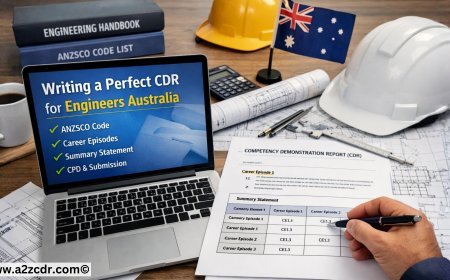








10 Expert Tips to Write a Perfect CDR for Engineers Australia
Discover the top 10 expert tips to write a perfect CDR for Engineers Australia and achieve a positive migration skill assessment result easily.


Table of Contents
- Introduction
- Understand What a CDR Really Is
- Choose the Right ANZSCO Code
- Focus on Your Career Episodes
- Showcase Engineering Problem-Solving Skills
- Maintain Originality – Avoid Plagiarism
- Write in Clear, Professional English
- Create a Strong Summary Statement
- Include a Detailed CPD (Continuing Professional Development)
- Follow the Correct Formatting and Presentation
- Seek Professional Help from A2ZCDR Writing Services
- Final Thoughts
-
Introduction
If you are an engineer dreaming of working and settling in Australia, then the Competency Demonstration Report (CDR) is your golden ticket. Engineers Australia (EA) — the designated assessing authority for most engineering occupations — uses the CDR to evaluate your skills, qualifications, and competencies against the Australian engineering standards.
A well-structured and perfectly written CDR can make the difference between receiving a positive migration skill assessment or facing rejection. Many engineers face difficulty understanding what Engineers Australia expects in a CDR and end up making mistakes that cost them time, money, and even career opportunities.
In this guide, we’ll explore the Top 10 tips to write a perfect CDR for Engineers Australia, ensuring your submission stands out and earns you the desired outcome.
-
Understand What a CDR Really Is
Before you start writing, you need to have a clear understanding of what a CDR actually represents. A Competency Demonstration Report (CDR) is a technical document used by Engineers Australia to assess whether your engineering qualifications and experience meet the Australian standards.
Your CDR is essentially your professional story, proving that you possess the knowledge, skills, and competencies required for your nominated ANZSCO occupation.
A complete CDR typically includes:
-
Three Career Episodes
-
A Summary Statement
-
Continuing Professional Development (CPD)
-
Curriculum Vitae (CV)
Each of these sections serves a specific purpose in demonstrating your engineering competence. Understanding their role will help you structure your report more effectively.
-
-
Choose the Right ANZSCO Code
Selecting the correct ANZSCO (Australian and New Zealand Standard Classification of Occupations) code is crucial before writing your CDR. Each engineering occupation is assigned a specific ANZSCO code that outlines:
-
The required qualifications
-
The job responsibilities
-
The competency standards
For example:
-
Civil Engineer – ANZSCO Code: 233211
-
Mechanical Engineer – ANZSCO Code: 233512
-
Electrical Engineer – ANZSCO Code: 233311
Your CDR must align closely with the competencies described under your selected code. If your CDR content doesn’t match your nominated occupation, Engineers Australia may reject your application.
Tip: Always cross-check the job duties under your chosen ANZSCO code and ensure your Career Episodes reflect them appropriately.
-
-
Focus on Your Career Episodes
The Career Episodes are the backbone of your CDR. Each Career Episode should describe a specific project, task, or experience that showcases your engineering skills and problem-solving abilities.
You must write three Career Episodes, each focusing on different stages or aspects of your engineering career:
-
An academic project
-
A professional work experience
-
A significant project or achievement
Each episode should be around 1000–2500 words and must be written in first person (using “I,” not “we”).
Each Career Episode should include:
-
Introduction (Approx. 100 words): Include the project title, duration, location, and your role.
-
Background (200–500 words): Explain the project’s context, objectives, and your responsibilities.
-
Personal Engineering Activity (500–1000 words): Describe the technical tasks you performed and the skills you applied.
-
Summary (50–100 words): Highlight your contributions and project outcomes.
Tip: Focus on your individual contributions — not the team’s. Engineers Australia wants to assess your competencies.
-
-
Showcase Engineering Problem-Solving Skills
One of the key things Engineers Australia looks for in a CDR is your ability to identify, analyze, and solve engineering problems. In your Career Episodes, make sure to:
-
Clearly describe the challenges or issues you faced.
-
Explain the steps and technical reasoning you used to solve them.
-
Highlight how your actions contributed to the project’s success.
For example:
“I identified that the water pressure in the distribution system was below the required standards. To resolve this, I conducted a hydraulic analysis using EPANET software and redesigned the pipeline network to achieve optimal flow distribution.”
Such detailed, results-driven descriptions demonstrate your analytical and technical competence effectively.
-
-
Maintain Originality – Avoid Plagiarism
Plagiarism is a serious offense in CDR writing. Engineers Australia uses advanced plagiarism detection software to verify the originality of submitted reports. If your CDR contains copied content from online samples, templates, or someone else’s report, your application could be rejected or banned for 12 months. To avoid this:
-
Write everything in your own words.
-
Use personal experiences and real data from your projects.
-
Never copy from sample CDRs or career episodes available online.
Tip: You can take professional guidance, but your experiences and descriptions must remain unique and authentic.
-
-
Write in Clear, Professional English
Your CDR report must be written in Australian English, with clear, concise, and grammatically correct language. Engineers Australia assesses not only your technical skills but also your communication abilities.
Here are a few language tips:
-
Use first-person active voice (e.g., “I designed,” “I implemented”).
-
Avoid overly technical jargon — focus on clarity and coherence.
-
Proofread for grammar, spelling, and punctuation errors.
-
Keep your tone formal yet personal — you’re telling your story as a professional engineer.
If English is not your first language, it’s advisable to get your report reviewed by a professional CDR writer or editor to ensure linguistic accuracy.
-
-
Create a Strong Summary Statement
The Summary Statement (SS) is one of the most important yet often misunderstood parts of the CDR. This document maps the competencies you’ve demonstrated in your Career Episodes to the competency elements listed in the Engineers Australia Stage 1 Competency Standards. Each paragraph in your Career Episodes should be numbered, and these references must be clearly mentioned in your Summary Statement.
For example:
-
PE1.1 — Paragraph 1.2 of Career Episode 1
-
PE1.2 — Paragraph 2.4 of Career Episode 3
Tip: Take time to carefully prepare your Summary Statement. It serves as a cross-reference that helps assessors quickly locate evidence of your competencies.
-
-
Include a Detailed CPD (Continuing Professional Development)
Your CPD statement showcases how you’ve kept your engineering knowledge up-to-date since completing your qualification. It should be presented in tabular format, including:
-
Title of the training/course
-
Date of completion
-
Duration
-
Institution or provider name
Examples of CPD activities include:
-
Workshops, conferences, and technical meetings
-
Postgraduate studies or certifications
-
Private study (reading journals, technical publications)
-
Seminars and webinars
Tip: Be honest — include only those activities you’ve actually completed and can verify if asked.
-
-
Follow the Correct Formatting and Presentation
Engineers Australia expects your CDR to follow a specific format and structure.
Presentation matters — a poorly formatted report can make even good content hard to evaluate. Here’s what to keep in mind:-
Use Times New Roman or Arial, size 12 font.
-
Maintain consistent headings and numbering throughout.
-
Label each section clearly — Introduction, Background, Personal Activity, Summary.
-
Include page numbers and ensure proper referencing (if required).
Tip: Before submission, convert your CDR to a PDF file to maintain consistent formatting.
-
-
Seek Professional Help from A2ZCDR Writing Services
Writing a perfect CDR can be a challenging and time-consuming process — especially if you’re not fully familiar with Engineers Australia’s requirements or the intricate details of ANZSCO codes and Stage 1 Competency Standards. Even a small mistake in formatting, structure, or content can lead to rejection or delays in your Migration Skill Assessment.
This is where A2ZCDR Writing Services comes to your rescue. Our team of expert CDR writers and professional engineers understands exactly what Engineers Australia expects from your CDR submission. We specialize in creating well-structured, plagiarism-free, and competency-based reports tailored to your engineering discipline.
At A2ZCDR Writing Services, we help you:
-
Review and edit your CDR to ensure full compliance with EA guidelines
-
Remove plagiarism and deliver an EA-approved, original CDR report
-
Align your Career Episodes accurately with your nominated ANZSCO occupation
-
Prepare your Summary Statement and CPD for a strong, well-rounded submission
By choosing professional assistance from A2ZCDR Writing Services, you ensure that your report meets all the requirements, reflects your true engineering capabilities, and significantly increases your chances of achieving a positive Migration Skill Assessment outcome from Engineers Australia. Take the stress out of CDR preparation — let our experts guide you to success.
-
-
Final Thoughts
Writing a CDR for Engineers Australia is not just about filling pages with technical jargon — it’s about presenting your engineering journey in a structured, evidence-based, and professional way.
By following these top 10 tips, you can craft a CDR that clearly showcases your skills, meets EA’s assessment standards, and brings you one step closer to achieving your dream of working and living in Australia.
If you’re unsure about your report or need expert guidance, A2Z CDR Writing Services is here to help. Our team of experienced CDR writers, editors, and engineers ensures your report meets all EA guidelines, is plagiarism-free, and tailored to your occupation.
Get in touch with our experts today at www.a2zcdr.comand take the first confident step toward your Australian Migration Skill Assessment success!
What's Your Reaction?
 Like
0
Like
0
 Dislike
0
Dislike
0
 Love
0
Love
0
 Funny
0
Funny
0
 Angry
0
Angry
0
 Sad
0
Sad
0
 Wow
0
Wow
0