











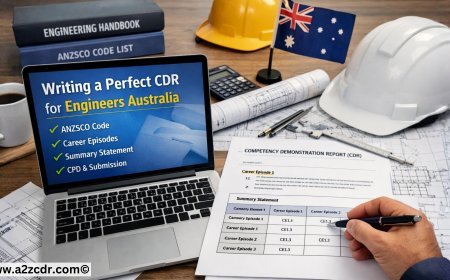








How to Avoid Rejection by Engineers Australia: Expert Tips for a Successful CDR
Avoid CDR rejection by Engineers Australia with expert tips, writing guidance, and assessment strategies. Learn how to prepare a flawless CDR for guaranteed approval.


Table of Contents
- Introduction
- Understanding Why Engineers Australia Rejects CDRs
- The Importance of Personal Engineering Contribution
- Originality and Plagiarism-Free Writing
- Choosing the Right ANZSCO Code
- Maintaining the Correct Structure and Format
- Using Clear Technical Language and Professional Tone
- Presenting Strong Engineering Problem-Solving Skills
- Providing Verified and Authentic Evidence
- The Importance of a Strong Summary Statement
- Why Professional Guidance Makes a Difference
- Final Thoughts: Ensuring a Positive Outcome
-
Introduction
Migration to Australia as a professional engineer begins with one of the most crucial steps—submitting a Competency Demonstration Report (CDR) to Engineers Australia. It is the document that determines whether your skills, qualifications, and engineering capabilities match the Australian engineering standards outlined in the Migration Skills Assessment (MSA) booklet. A positive assessment can open the door to Australian Permanent Residency, while a rejection can delay dreams, cause unnecessary stress, and force you to redo months of effort.
Many engineers underestimate the complexity of CDR writing. They assume that describing their job duties or copying templates from the internet is enough. However, Engineers Australia follows strict assessment guidelines, and any mistake—whether technical, structural, or ethical—can lead to rejection. Understanding what Engineers Australia expects and preparing your CDR accordingly is the key to a successful outcome.
This article explains the most common reasons behind CDR rejections and provides expert-level advice on how to avoid them. With the right strategy, clarity, originality, and professional presentation, you can significantly increase your chances of a positive assessment.
-
Understanding Why Engineers Australia Rejects CDRs
Engineers Australia does not reject a CDR randomly; every rejection is based on clear criteria. Engineers Australia looks for evidence of engineering knowledge, problem-solving ability, project involvement, and personal contribution. They also evaluate the accuracy of information, originality of writing, compliance with ANZSCO requirements, and alignment with Australian engineering standards.
The most common reasons for rejection include plagiarism, a lack of technical detail, overly generic content, incorrect selection of ANZSCO codes, poor structure, inadequate personal involvement, and incomplete documentation. Understanding these triggers is essential for crafting a well-prepared CDR that meets all expectations.
-
The Importance of Personal Engineering Contribution
One of the most frequent reasons for a negative assessment is the inability to demonstrate one’s own contribution to engineering projects. Engineers Australia does not evaluate the project itself; they evaluate your involvement in it. If the Career Episodes contain only general descriptions, team responsibilities, or textbook-level explanations, it becomes difficult for the assessor to understand what the applicant personally accomplished.
A successful Career Episode is rich in detail. It showcases your engineering decisions, design calculations, technical challenges you solved, tools you selected, and your justification for each important step. Engineers Australia wants to see your thought process and how you applied engineering knowledge to real-world situations. Avoiding passive descriptions and focusing on your direct role is the foundation of a high-quality CDR.
-
Originality and Plagiarism-Free Writing
One of the strictest standards enforced by Engineers Australia concerns plagiarism. Thousands of CDRs are rejected each year due to copied material—whether intentionally or unintentionally. Copying from sample career episodes, online templates, or previously submitted CDRs is strictly prohibited. Engineers Australia uses advanced plagiarism-detection systems, and even small similarities can be flagged.
Originality is not optional; it is mandatory. Even if you worked on a common engineering project, your explanation must be unique and personal. Describe your experience, not generic engineering content. Avoid copying theoretical definitions, standard methodologies, or technical explanations from books or websites. Instead, express what you learned, how you applied the theories, and what outcomes you achieved.
If you feel unsure about how to express your engineering tasks without unintentional similarity, professional CDR writing services like A2Z CDR Writing Services can help ensure your content maintains originality while staying aligned with Engineers Australia’s expectations.
-
Choosing the Right ANZSCO Code
Selecting the correct ANZSCO code is fundamental to your CDR’s success. Each engineering occupation—whether it is Civil Engineer, Electrical Engineer, Telecommunications Engineer, Mechanical Engineer, Engineering Technologist, or Engineering Manager—has its own responsibilities and competency requirements. If your Career Episodes do not match these expectations, the assessor may conclude that your experience is not relevant.
This mismatch often causes unnecessary rejections. Engineers must carefully analyze job duties mentioned under their ANZSCO occupation and align their Career Episodes accordingly. The episodes should reflect tasks, responsibilities, and competencies expected for that specific code. Correct alignment enhances credibility and ensures Engineers Australia can confidently assess your suitability for that role.
-
Maintaining the Correct Structure and Format
Engineers Australia requires a very specific structure for Career Episodes, Summary Statements, and CPD documentation. Any deviation from the expected format can confuse the assessor and reduce your chances of success. Incorrect formatting, missing sections, or poorly written summaries can make your CDR appear unprofessional and incomplete.
A Career Episode must include an introduction, background, personal engineering activity, and summary. The Summary Statement must map each paragraph to the required competency elements. Since this mapping is used by Engineers Australia to evaluate your engineering abilities, accuracy is essential. Many applicants struggle with this step because it requires a deep understanding of the competency indicators from the MSA booklet.
A polished and well-organized CDR not only shows professionalism but also demonstrates respect for the assessment process.
-
Using Clear Technical Language and Professional Tone
Engineers Australia expects your CDR to reflect your engineering knowledge. This requires using logical, technical, and formal language. Overly casual writing, vague descriptions, or storytelling-style narratives weaken the report. At the same time, excessively complex language or excessive use of jargon can make the content hard to follow.
A balanced writing style works best—professional, clear, focused, and technically relevant. The assessor should be able to understand your engineering decisions, calculations, challenges faced, and solutions implemented without unnecessary complications.
Good writing is not only about grammar; it is about clarity. A CDR that communicates effectively is far more persuasive than one filled with advanced vocabulary but weak technical explanation.
-
Presenting Strong Engineering Problem-Solving Skills
Engineers Australia wants to assess your ability to solve engineering problems. Your CDR must demonstrate this skill through real examples from your academic or professional experience. Simply listing tasks or describing project timelines is not enough. The assessor must be able to identify where you used engineering judgment, analytical skills, and creative solutions.
A strong Career Episode highlights the challenges you encountered and how you tackled them using engineering principles. It explains the reasoning behind your decisions, the tools or techniques you used, and the positive impact of your contributions. This level of clarity shows Engineers Australia that you possess the competencies required to practice engineering in Australia.
-
Providing Verified and Authentic Evidence
Every claim in your CDR must be supported by authentic documentation. Engineers Australia may reject CDRs that include unverifiable information, exaggerated claims, or inaccurate details. Your CV, employment letters, project reports, or duties must match the content written in your Career Episodes.
If inconsistencies arise during assessment, Engineers Australia may request additional documents, clarification, or—if discrepancies persist—reject the application. Transparency and accuracy are always the safest path to approval.
-
The Importance of a Strong Summary Statement
The Summary Statement is one of the most important parts of your CDR. Many applicants underestimate it, focusing all their energy on Career Episodes. However, the Summary Statement is the section that helps Engineers Australia quickly identify whether you have demonstrated each competency element required for your ANZSCO occupation.
If your Summary Statement does not clearly map your achievements to the competency indicators, the assessor may conclude that important elements are missing. This leads to rejection even when your Career Episodes were well-written. A strong Summary Statement showcases your capabilities and ensures nothing is overlooked during evaluation.
-
Why Professional Guidance Makes a Difference
CDR writing requires a unique combination of engineering expertise, technical writing skills, understanding of migration requirements, and knowledge of Engineers Australia’s guidelines. Many applicants struggle even after multiple attempts because the process is far more detailed than they expect.
Professional CDR writing experts, such as those at A2Z CDR Writing Services, specialize in preparing high-quality, compliant, plagiarism-free CDR reports. They help engineers identify suitable projects, structure Career Episodes, craft Summary Statements, and ensure perfect alignment with ANZSCO expectations. This guidance not only strengthens your CDR but also minimizes the risk of rejection.
Professionals stay updated with changes in Engineers Australia policies, formatting expectations, and assessment standards. They understand what assessors look for and can guide you to present your skills in the strongest possible manner.
-
Final Thoughts: Ensuring a Positive Outcome
Avoiding CDR rejection requires proper planning, strong technical writing, accurate documentation, and complete alignment with Engineers Australia guidelines. A successful CDR does not rely on fancy language—it relies on clarity, originality, and professional presentation of your engineering experience.
By focusing on personal contribution, matching ANZSCO requirements, maintaining structure, avoiding plagiarism, and presenting authentic evidence, you can significantly improve your chances of receiving a positive assessment.
If you want your CDR to stand out with precision and professional excellence, expert assistance from A2Z CDR Writing Services ensures you submit a report that reflects your true engineering capabilities and meets every requirement set by Engineers Australia.
For expert assistance with CDR writing, Career Episodes, Summary Statements, and complete Migration Skill Assessment support, visit A2Z CDR Writing Services at
If you’d like to discuss your case directly with our team, connect with us on WhatsApp.Our specialists are ready to guide you toward a successful Engineers Australia assessment outcome.
What's Your Reaction?
 Like
0
Like
0
 Dislike
0
Dislike
0
 Love
0
Love
0
 Funny
0
Funny
0
 Angry
0
Angry
0
 Sad
0
Sad
0
 Wow
0
Wow
0