











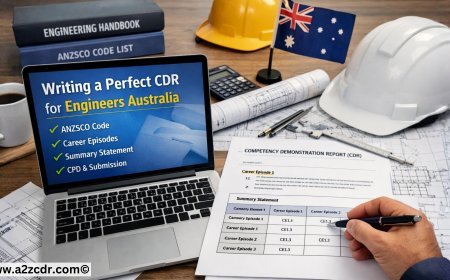








Writing Career Episodes Based on Academic vs. Professional Projects
Learn how to write strong Career Episodes for Engineers Australia using academic or professional projects. Understand EA requirements and improve your CDR success rate.


Preparing a high-quality Competency Demonstration Report (CDR) for Engineers Australia requires more than simply describing your background or listing your responsibilities. The core of your CDR lies in the three Career Episodes, each demonstrating a different aspect of your engineering experience. This experience can come from either academic projects or professional work, and many applicants often wonder which is better—or whether mixing both is acceptable.
Both types of projects can be used effectively, but they differ in structure, complexity, and the competencies they highlight. Understanding these differences helps you present a convincing, well-developed narrative that meets Engineers Australia’s standards. Whether you are a recent graduate relying on academic work or an experienced engineer showcasing professional responsibilities, your Career Episodes must be personal, technical, and aligned with your ANZSCO occupation.
Understanding the Role of Career Episodes
Career Episodes are designed to reveal your engineering thought process, technical capabilities, problem-solving approach, and individual contribution. Rather than summarizing group achievements or organizational milestones, each episode must illustrate what you personally did to achieve a specific engineering outcome. Engineers Australia expects you to take readers through your project’s background, your responsibilities, the challenges you encountered, and how you applied engineering knowledge to address them.
Because applicants come from diverse backgrounds—some with years of industry experience and others with strong academic credentials—Engineers Australia accepts both academic and professional projects. What matters most is demonstrating competencies through detailed, original, and plagiarism-free narratives written in the first person.


Using Academic Projects for Career Episodes
Academic projects are particularly useful for fresh graduates, applicants with limited industry experience, or those from regions where engineering roles may not align directly with Australian standards. Academic work can include final-year projects, capstone design work, thesis research, laboratory investigations, team projects, or internships.
The strength of academic episodes lies in the opportunity to showcase theoretical foundations, research-based decision-making, analytical methods, and conceptual design. These projects often highlight your ability to apply engineering principles, use specialized software, perform simulations, analyze data, and document technical work. Even if academic projects lack the scale or professional context of industry assignments, they remain a valid and often effective way to demonstrate engineering competency.
One important aspect of using academic projects is ensuring that your personal involvement is clearly described. Many students participate in group projects, but Engineers Australia evaluates your competency—not your team’s performance. You must explain what tasks you handled, what decisions you made, and how your engineering judgment influenced the outcome. A well-written academic episode can be just as strong as a professional one if it is detailed, personal, and technically sound.
Using Professional Projects for Career Episodes
Professional projects offer a richer opportunity to discuss real-world engineering challenges, organizational responsibilities, and tangible outcomes. Engineers Australia generally prefers professional experience when available, as it demonstrates your ability to function in a workplace, follow engineering codes and standards, collaborate with stakeholders, solve operational problems, and manage deadlines.
In professional episodes, you can highlight your role in project planning, design, implementation, testing, site supervision, troubleshooting, or process optimization. You can also demonstrate competencies related to communication, teamwork, safety practices, quality assurance, and environmental considerations. These experiences typically present a deeper level of complexity and responsibility than academic projects.

However, professional episodes require additional care in handling confidential information. You must ensure the content is original and not copied from company documents or earlier reports. You should also avoid mentioning sensitive proprietary data. Engineers Australia is primarily concerned with your competencies, not classified project details, so focus on describing your personal engineering contributions using your own words.
Key Differences Between Academic and Professional Episodes
Although both types follow the same structural requirements, they differ in focus and context. Academic episodes often emphasize theoretical knowledge, design methodologies, and engineering fundamentals. Professional episodes highlight practical problem-solving, industry standards, and responsibilities within real operations.
Academic episodes may rely more on simulations, models, and research outcomes, while professional ones often include budget constraints, stakeholder interactions, risk assessments, worksite conditions, and project delivery. However, both must center on your personal actions. Whether you performed a laboratory test or supervised field installation activities, what matters is how you explain the engineering reasoning behind your decisions.
Finding the Right Balance: Should You Mix Both?
Many successful applicants use a combination of academic and professional episodes, especially if their work experience does not fully cover all competency areas. For example, an engineer may have extensive industry experience in project supervision but rely on an academic project to demonstrate design or analytical expertise. Another may use professional projects for two episodes and an academic one for the third.
There is no requirement to use only professional projects or only academic ones. Your goal is to present the strongest possible evidence of competency across all episodes. If academic work better highlights your technical strengths, it is completely acceptable to include it. If professional experience showcases leadership and applied engineering judgment, that too is valuable.
Making Your Episodes Strong and Compliant
Regardless of whether the episode is academic or professional, clarity, originality, and technical depth are essential. Engineers Australia expects you to write in the first person, describe tasks in detail, and demonstrate your engineering problem-solving approach. Avoid general descriptions or statements that could apply to anyone. Each paragraph should reflect your role, your understanding, and the engineering decisions you made.
Many applicants struggle with articulating their involvement clearly or aligning their projects with the correct ANZSCO code. This is where professional guidance becomes valuable. Expert CDR consultants ensure your episodes satisfy EA standards, remain plagiarism-free, and effectively represent your skill level. Services such as A2Z CDR Writing Services help applicants structure their narratives, refine technical content, and avoid common mistakes that lead to rejection.
Final Thoughts
Writing strong Career Episodes—whether based on academic or professional work—is essential for achieving a positive Migration Skill Assessment with Engineers Australia. What matters most is the ability to communicate your engineering capability through well-structured narratives that are detailed, personal, and aligned with EA standards. Academic projects highlight your analytical and theoretical strengths, while professional projects demonstrate your applied engineering expertise. A thoughtful combination of both can create a balanced, powerful CDR that reflects your full range of abilities.
If you want professional help ensuring your Career Episodes meet Engineers Australia’s expectations, A2Z CDR Writing Services provides expert guidance, detailed reviews, and complete CDR support to help you submit a strong, compliant, and successful application.
What's Your Reaction?
 Like
0
Like
0
 Dislike
0
Dislike
0
 Love
0
Love
0
 Funny
0
Funny
0
 Angry
0
Angry
0
 Sad
0
Sad
0
 Wow
0
Wow
0