Migrating to Australia as an engineer is a dream for many professionals worldwide, but achieving this goal requires successfully passing the Engineers Australia (EA) Migration Skills Assessment. At the heart of this assessment lies the Competency Demonstration Report (CDR), a technical and professional document that proves your engineering knowledge, skills, and experience meet Australian standards.
Many engineers underestimate the importance of the CDR or treat it as a simple formality. In reality, it is one of the most critical documents in your migration journey. Even highly qualified engineers face rejection due to poorly structured CDRs, incorrect formatting, weak competency mapping, or failure to follow Engineers Australia guidelines.
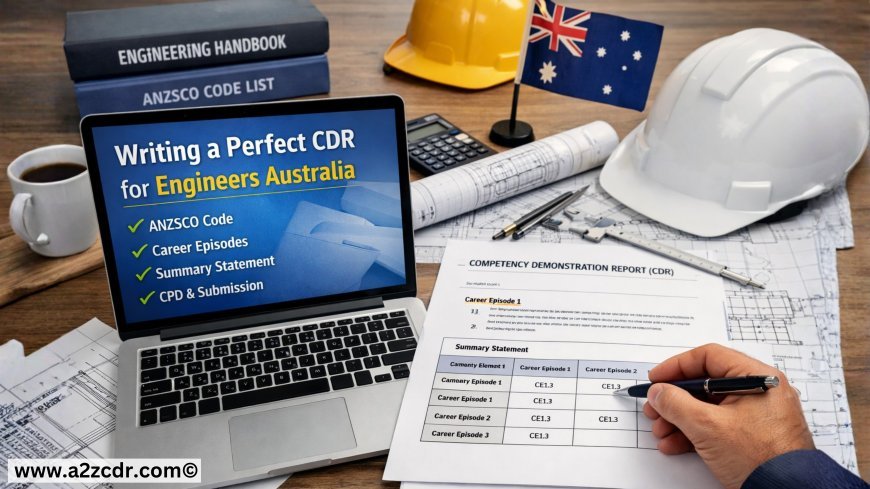
This comprehensive step-by-step guide explains how to write a perfect CDR for Engineers Australia, covering every stage of the process—from understanding requirements to final submission—so you can maximise your chances of a positive assessment.
Understanding What a CDR Is and Why It Matters
A Competency Demonstration Report is a detailed written representation of your engineering career. It demonstrates how your education and professional experience align with the competency standards set by Engineers Australia for your nominated occupation.
Engineers Australia uses the CDR to evaluate engineers whose qualifications are not accredited under the Washington Accord, Sydney Accord, or Dublin Accord. Through this report, assessors determine whether you possess the required engineering competencies, technical depth, professional judgment, and ethical awareness expected of engineers working in Australia.
Your CDR is not evaluated based on your job title or years of experience alone. Instead, it is assessed on how effectively you explain your engineering work, problem-solving approach, and decision-making process using real projects from your academic or professional life.
Step 1: Choose the Correct ANZSCO Occupation Code
Before writing anything, selecting the correct ANZSCO code is essential. This decision determines how your entire CDR will be assessed. Each ANZSCO occupation describes specific engineering roles, responsibilities, and skill requirements. Engineers Australia evaluates your Career Episodes and Summary Statement strictly against the occupation you nominate.
Choosing an incorrect ANZSCO code is one of the most common reasons for CDR rejection. Your job title alone is not enough to decide the code. Instead, you must analyse your daily responsibilities, technical work, tools used, and engineering outcomes achieved.
For example, a “Project Engineer” could fall under civil, mechanical, electrical, or even engineering management, depending on their actual responsibilities. Your selected ANZSCO code must accurately reflect the majority of your engineering work.
Step 2: Understand Engineers Australia Competency Standards
Engineers Australia assesses CDRs based on competency standards specific to your occupation category, such as Professional Engineer, Engineering Technologist, or Engineering Associate. Each category has defined competency elements grouped under areas like knowledge and skill base, engineering application ability, and professional and personal attributes.
Understanding these competency elements is crucial because your Summary Statement must directly map your Career Episode paragraphs to these competencies. Without a clear understanding of what assessors are looking for, your CDR will lack focus and direction. A strong CDR is written with these competency standards in mind from the very beginning, not added as an afterthought.
Step 3: Prepare Your Continuing Professional Development (CPD) List
The CPD section shows Engineers Australia that you are committed to continuous learning and professional growth. This section is presented as a list, not an explanation. It includes formal education, training programs, workshops, seminars, online courses, webinars, and technical reading relevant to your engineering field.
The CPD list should reflect learning activities from recent years and align with your nominated occupation. Random or unrelated activities weaken your CDR and raise doubts about your professional focus. Although CPD is not heavily descriptive, accuracy and relevance are important. Any inconsistencies between your CPD and Career Episodes may attract further scrutiny.
Step 4: Write Strong Career Episodes
Career Episodes form the core of your CDR. Engineers Australia requires three Career Episodes, each describing a specific engineering project or role where you personally applied engineering knowledge and skills. These episodes can be based on academic projects, professional work, internships, or research activities. However, they must involve genuine engineering tasks and responsibilities.
Structure of a Career Episode: Each Career Episode must follow a clear structure, including an introduction, background, personal engineering activity, and summary. The introduction briefly outlines the project title, location, duration, and your role. The background explains the project context, objectives, and organisational structure. The personal engineering activity is the most critical part, where you describe what you personally did, how you solved problems, and what engineering principles you applied. The summary highlights the outcomes and lessons learned.
Focus on Personal Contribution: Engineers Australia expects Career Episodes to be written in the first person, using “I” statements. This helps assessors understand your individual contribution rather than the team’s work. Avoid generic descriptions, copied material, or company-focused narratives. Instead, explain your thought process, decisions, challenges faced, and solutions implemented. This demonstrates competency far more effectively than listing responsibilities.
Technical Depth and Clarity: Your Career Episodes should include appropriate technical details such as calculations, design considerations, standards followed, tools used, software applications, and testing methods. However, the explanation should remain clear and professional, not overly complex or vague. Balance is key. Overly simplistic descriptions may appear weak, while excessive technical jargon without explanation can confuse assessors.
Step 5: Avoid Plagiarism at All Costs
Engineers Australia has a strict zero-tolerance policy for plagiarism. Even unintentional similarity with online samples, colleagues’ reports, or previous submissions can lead to immediate rejection and possible bans. Your CDR must be entirely original and written specifically based on your own experience. Reusing templates, copying phrases, or paraphrasing published examples is risky.
Professional CDR writers ensure originality by crafting content from scratch while maintaining compliance with EA guidelines.
Step 6: Write a Clear and Accurate Summary Statement
The Summary Statement is often misunderstood but plays a critical role in the assessment process. It is not a summary of your Career Episodes. Instead, it is a competency-mapping document. In the Summary Statement, you must link each competency element to specific paragraph numbers from your Career Episodes where that competency is demonstrated.
This requires precision. Incorrect mapping, missing references, or vague explanations can lead to rejection even if your Career Episodes are strong. Each competency claim must be supported by evidence from your Career Episodes. Engineers Australia assessors use the Summary Statement as a roadmap to verify your competencies.
Step 7: Prepare a Professional Curriculum Vitae (CV)
Your CV supports your CDR by providing a chronological overview of your education and work experience. It should be clear, concise, and aligned with your Career Episodes. Any inconsistencies in dates, roles, or responsibilities can raise red flags during assessment. Avoid exaggeration or irrelevant information. Your CV should reinforce the engineering competencies demonstrated in your CDR.
Step 8: Format Your CDR According to EA Guidelines
Formatting errors may seem minor, but they can negatively affect the overall impression of your application. Engineers Australia requires clear formatting, consistent font style, appropriate headings, and correct paragraph numbering in Career Episodes. Each section of the CDR must be clearly labelled and organised. Proper formatting improves readability and helps assessors easily navigate your document.
Step 9: Review, Proofread, and Cross-Check
Before submission, review your entire CDR thoroughly. Check for grammatical errors, spelling mistakes, unclear sentences, and technical inconsistencies.
Ensure that paragraph numbers in Career Episodes match those referenced in the Summary Statement. Confirm that your CPD aligns with your engineering field and that your CV reflects the same experience described elsewhere. Many rejections occur due to simple oversights that could have been avoided with careful review.
Step 10: Submit Your CDR with Confidence
Once your CDR is complete, submit it through the Engineers Australia online portal along with required documents and fees. A well-prepared CDR reflects professionalism, competence, and attention to detail—qualities Engineers Australia values highly.
Common Reasons CDRs Get Rejected
Understanding common mistakes can help you avoid them. These include choosing the wrong ANZSCO code, weak Career Episodes, lack of personal contribution, poor Summary Statement mapping, plagiarism, inconsistent information, and ignoring EA guidelines. A perfect CDR is not just about writing skills—it is about strategy, compliance, and clarity.
How Professional CDR Writing Services Can Help
Writing a CDR is a technical and demanding task. Many engineers seek professional assistance to improve their chances of success. Expert CDR consultants review your background, select the correct ANZSCO code, structure your Career Episodes, ensure proper competency mapping, maintain originality, and format the report according to EA standards. With professional guidance, you avoid costly mistakes, save time, and significantly increase your chances of a positive skills assessment.
Writing a perfect CDR for Engineers Australia requires careful planning, technical understanding, and strict adherence to guidelines. It is not a generic document but a personalised demonstration of your engineering capabilities and professional competence. By following this step-by-step guide, understanding EA expectations, writing strong Career Episodes, preparing an accurate Summary Statement, and ensuring originality and compliance, you can submit a confident and compelling CDR.
For engineers serious about migrating to Australia, investing time, effort, or professional support in preparing a high-quality CDR is not optional—it is essential. A well-written CDR opens the door to a successful Engineers Australia assessment and brings you one step closer to your Australian engineering career.

























 Like
0
Like
0
 Dislike
0
Dislike
0
 Love
0
Love
0
 Funny
0
Funny
0
 Angry
0
Angry
0
 Sad
0
Sad
0
 Wow
0
Wow
0