












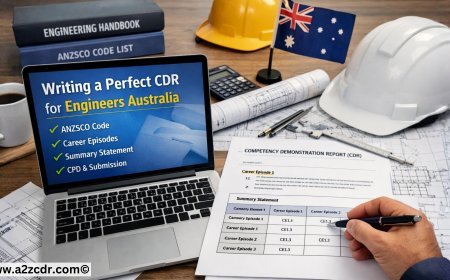








How Electronics Engineers Can Write a Perfect CDR for Engineers Australia
Learn what to include in a CDR for Electronics and Communication Engineers, covering Career Episodes, Summary Statement, CPD, ANZSCO codes, and Engineers Australia guidelines.


For Electronics and Communication Engineers planning to migrate to Australia, preparing a Competency Demonstration Report (CDR) is one of the most crucial steps in the Migration Skill Assessment process. Engineers Australia (EA), the authorized assessing body for engineering occupations, uses the CDR to evaluate whether an applicant’s qualifications, skills, and professional experience meet Australian engineering standards. For Electronics and Communication Engineers, this process can be particularly challenging due to the broad and multidisciplinary nature of the field.
Electronics and Communication Engineering covers diverse domains such as telecommunications, signal processing, embedded systems, networking, microelectronics, VLSI, control systems, and digital communication. When writing a CDR, it is essential to clearly demonstrate how your specific experience fits within Engineers Australia’s competency framework and aligns with the relevant ANZSCO occupation. A well-prepared CDR not only improves your chances of a positive assessment but also positions you as a capable professional ready to contribute to Australia’s engineering sector.
This detailed guide explains exactly what to include in a CDR report for Electronics and Communication Engineers, how to structure each section, and how to avoid common mistakes that lead to rejection.
Understanding the Purpose of a CDR for Electronics and Communication Engineers
The CDR is designed to assess whether your engineering knowledge and professional experience are equivalent to Australian engineering standards. Engineers Australia focuses on competency, not just qualifications. Even if you hold a strong academic degree, you must still prove that you can apply engineering principles effectively in practical situations.


For Electronics and Communication Engineers, this means demonstrating your ability to design, analyze, implement, test, and maintain electronic and communication systems. Engineers Australia expects clear evidence of problem-solving, engineering judgment, technical decision-making, and professional responsibility.
The CDR provides Engineers Australia with insight into how you work as an engineer, how you approach complex technical challenges, and how you contribute to engineering projects. It must be written in your own words, focus on your individual role, and strictly follow EA’s guidelines.
Choosing the Correct ANZSCO Code
Before writing your CDR, selecting the appropriate ANZSCO code is essential. Electronics and Communication Engineers typically apply under one of the following occupations:
- ANZSCO 233411 – Electronics Engineer
- ANZSCO 233311 – Electrical Engineer (for roles overlapping with power systems or control engineering)
- ANZSCO 263311 – Telecommunications Engineer (for ICT-focused communication roles)
Your chosen ANZSCO code determines the competency elements against which your CDR will be assessed. Engineers Australia will compare your Career Episodes, Summary Statement, and CPD with the tasks and responsibilities listed under that occupation. Choosing an incorrect ANZSCO code is one of the most common reasons for negative assessments, even when the engineering experience itself is strong.
Your CDR content must consistently support the selected ANZSCO code throughout all sections.
Key Components of a CDR Report


A complete CDR report for Electronics and Communication Engineers consists of four mandatory documents: three Career Episodes, a Summary Statement, a Continuing Professional Development (CPD) list, and a professional CV. Each component plays a distinct role in demonstrating your engineering competency.
Career Episodes: The Core of Your CDR
Career Episodes are the most important part of your CDR. They allow Engineers Australia to evaluate your engineering skills through real-life examples. Each Career Episode should describe a specific project or period of work where you applied electronics and communication engineering principles.
Career Episodes must be written in the first person and focus on your personal engineering activities. Teamwork can be mentioned, but the emphasis must always remain on what you personally did, decided, designed, or solved.
Introduction Section
The introduction provides basic information about the project or role. For Electronics and Communication Engineers, this may include details about a telecommunications project, embedded system development, signal processing application, or electronics design assignment. You should clearly state the project title, duration, organization or institution, and your position at the time.
This section should be concise and factual, setting the context for the rest of the episode.
Background Section
The background explains the overall context of the project. Here, you should describe the project objectives, the technical environment, and the engineering challenges involved. For example, you may explain the need for a communication system upgrade, development of a microcontroller-based solution, or implementation of a wireless network.
You can also mention relevant standards, technologies, tools, and methodologies used during the project. This section helps Engineers Australia understand the scale and complexity of the engineering work.
Personal Engineering Activity
This is the most critical part of the Career Episode. Electronics and Communication Engineers must clearly demonstrate their technical expertise and problem-solving abilities. You should describe how you applied engineering theories and principles to achieve project objectives.
Depending on your specialization, this section may include activities such as circuit design and simulation, signal analysis, PCB layout, microcontroller programming, embedded system integration, network design, RF analysis, or system testing and troubleshooting. You should explain how you analyzed requirements, selected appropriate components or technologies, performed calculations or simulations, and validated system performance.
Engineers Australia expects you to show evidence of engineering judgment. You should explain why you chose certain approaches, how you handled technical constraints, and how you resolved issues encountered during the project. This section must be detailed, technical, and focused on your individual contribution.
Summary Section
The summary concludes the Career Episode by highlighting the outcomes of the project. You should briefly explain what you achieved, what skills you developed, and how the project enhanced your engineering competence. This section reinforces your professional growth and demonstrates the practical value of your engineering work.
Writing Career Episodes for Academic and Professional Projects
Electronics and Communication Engineers can use both academic and professional projects in their Career Episodes. Academic projects should demonstrate applied engineering skills, not just theoretical learning. Final-year projects, laboratory-based design projects, and research-oriented engineering work are commonly accepted when written correctly.
Professional projects should focus on real-world engineering responsibilities and outcomes. Engineers Australia places strong emphasis on industry experience, so professional projects often carry more weight. However, academic projects are acceptable if they demonstrate substantial engineering application.
Regardless of project type, the key requirement is to demonstrate engineering competence clearly and honestly.
Summary Statement: Mapping Your Competencies
The Summary Statement is a structured document that maps the competency elements required by Engineers Australia to specific paragraphs in your Career Episodes. For Electronics and Communication Engineers, this includes demonstrating engineering knowledge, problem-solving skills, communication abilities, and professional conduct.
Each competency element must be addressed with references to exact paragraph numbers from your Career Episodes. Engineers Australia uses this document to verify that your Career Episodes collectively cover all required competencies. Accuracy is critical in the Summary Statement. Incorrect mapping, missing elements, or irrelevant references can lead to rejection even if the Career Episodes are strong.
Continuing Professional Development (CPD)
CPD demonstrates your commitment to staying current in your engineering field. Electronics and Communication Engineering is a rapidly evolving discipline, and Engineers Australia expects applicants to keep their knowledge updated.
Your CPD list should include activities such as technical training programs, online courses, seminars, workshops, certifications, conferences, webinars, and self-study. Each entry should include the title, date, duration, and type of activity. CPD does not need to be extensive, but it must be relevant to your engineering field and show ongoing learning.
Preparing a Professional CV
Your CV should complement your CDR by summarizing your education, work experience, and technical skills. For Electronics and Communication Engineers, it should clearly outline your roles, responsibilities, tools used, and key achievements. Consistency between your CV and CDR is essential. Any discrepancies may raise concerns during assessment.
Common Mistakes Electronics and Communication Engineers Must Avoid
Many CDR applications are rejected due to avoidable errors. One of the most common mistakes is plagiarism. Engineers Australia uses advanced plagiarism detection tools, and copied or template-based content can result in immediate rejection and possible bans.
Another frequent issue is writing Career Episodes in a generic or descriptive manner rather than focusing on personal engineering activities. Using passive language or emphasizing team efforts without clarifying individual contributions weakens your application. Incorrect ANZSCO code selection, poor Summary Statement mapping, insufficient technical detail, and failure to follow EA formatting guidelines are also common reasons for negative outcomes.
Importance of Language, Tone, and Formatting
Your CDR must be written in clear, professional English. Engineers Australia accepts both British and Australian English, but consistency is important. The tone should be technical yet easy to understand, avoiding unnecessary jargon or informal language. Proper formatting, paragraph numbering, clear headings, and logical flow improve readability and demonstrate professionalism.
How Professional CDR Writing Services Can Help
Preparing a CDR for Electronics and Communication Engineers can be complex and time-consuming. Professional assistance from experienced consultants can significantly reduce the risk of errors.
A2Z CDR Writing Services offers expert support tailored specifically to Electronics and Communication Engineers. Their team understands Engineers Australia’s competency framework, ANZSCO requirements, and technical expectations. They assist with ANZSCO code selection, Career Episode drafting, Summary Statement mapping, CPD preparation, and plagiarism checks. Professional guidance ensures your CDR is accurate, compliant, and strategically structured for a positive assessment outcome.
A well-prepared CDR report is the foundation of a successful Migration Skill Assessment for Electronics and Communication Engineers. Engineers Australia expects clear evidence of engineering competence, practical application of technical knowledge, and professional integrity. Every section of your CDR—from Career Episodes to the Summary Statement and CPD—must work together to present a consistent and compelling engineering profile.
By understanding what to include in your CDR, choosing the correct ANZSCO code, focusing on personal engineering activities, and avoiding common mistakes, you can significantly improve your chances of success. With careful preparation and, if needed, expert guidance from A2Z CDR Writing Services, your CDR can become a powerful document that supports your goal of building a successful engineering career in Australia.
What's Your Reaction?
 Like
0
Like
0
 Dislike
0
Dislike
0
 Love
0
Love
0
 Funny
0
Funny
0
 Angry
0
Angry
0
 Sad
0
Sad
0
 Wow
0
Wow
0