












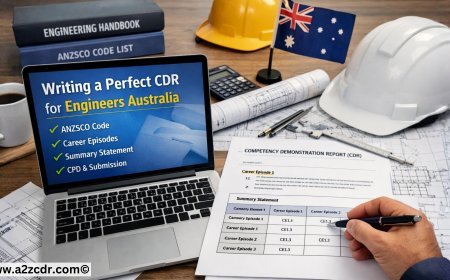








How to Write CDR Reports for Different Engineering Occupations
Learn how to write occupation-specific CDR reports for Engineers Australia. Understand Career Episodes, Summary Statements, and tailored engineering competencies for a successful assessment.


Preparing a Competency Demonstration Report (CDR) for Engineers Australia is one of the most important steps in the Migration Skills Assessment process. For many engineers applying for skilled migration, the CDR becomes the deciding factor that determines whether they receive a positive assessment or face rejection. While thousands of engineers submit CDRs every year, a large number are unsuccessful not because they lack skills or experience, but because their CDR reports are poorly aligned with their engineering occupation.
Writing a CDR is not a one-size-fits-all process. Civil engineers cannot submit the same style of technical evidence as mechanical engineers. Electrical engineers cannot rely on the same competency demonstration as industrial engineers. Each engineering occupation listed under the ANZSCO classification has its own unique responsibilities, expectations, and competency indicators. Therefore, understanding how to tailor your CDR to your specific engineering occupation is essential for a successful assessment.
This comprehensive guide explores how engineers can prepare occupation-specific CDR reports, how the content should vary across different fields, how to match your experience with Engineers Australia’s expectations, and how professional CDR writers—such as A2Z CDR Writing Services—can help you create a winning application.
Why Engineering Occupation Matters in CDR Writing
Before diving into the details of how to write occupation-specific CDR reports, it is important to understand why your engineering occupation matters so much. Engineers Australia does not assess your application based on your job title or your degree alone. Instead, they evaluate whether your actual responsibilities, projects, and problem-solving approaches align with the occupational description listed in the ANZSCO code you have chosen.


Every engineering occupation has explicit competency requirements. A structural engineer is expected to demonstrate expertise in structural analysis, load calculations, material behaviour, and safety assurance. A mechanical engineer, in contrast, must exhibit capability in mechanical systems, design optimization, thermodynamics, and equipment performance. These expectations are embedded in the occupational standards defined in ANZSCO, which serve as the framework for Engineers Australia.
The relevance of your CDR content to your engineering occupation is therefore critical. If your experience does not align with the tasks and duties of the occupation you claim, your CDR may not pass the assessment—even if your episodes are well written.
Writing Career Episodes for Different Engineering Occupations
Career Episodes are the foundation of your CDR report. These are detailed narratives describing your engineering background, responsibilities, and accomplishments. To write effective Career Episodes, you must align your content with the engineering occupation you selected. Each episode should demonstrate your personal engineering contribution—not your team’s or company’s achievements.
Below is a breakdown of how Career Episodes vary depending on different engineering occupations.
1. Writing CDRs for Civil Engineers
Civil engineers typically work on construction, infrastructure, transportation, hydrology, structural analysis, and geotechnical projects. Career Episodes for civil engineers must reflect strong involvement in civil works, design calculations, planning, and site management.


Civil engineers should demonstrate activities such as preparing design documentation, performing structural analyses, supervising construction works, carrying out soil testing, ensuring safety compliance, and coordinating with architects and contractors. Engineers Australia expects clear indications of technical judgement, regulatory awareness, and hands-on engineering tasks.
Episodes should also integrate detailed calculations, site challenges, design justification, and engineering solutions. Civil engineering is broad, but your episodes must reflect consistent alignment with the civil discipline.
2. Writing CDRs for Mechanical Engineers
Mechanical engineers handle mechanical systems, machinery, design optimization, thermal processes, equipment maintenance, and automation. A Career Episode for mechanical engineers should showcase proficiency in design tools, mechanical analysis, CAD software, and engineering testing.
Engineers Australia expects you to demonstrate mechanical problem-solving, equipment performance improvement, stress analysis, heat transfer, vibration analysis, and optimization of mechanical processes. Career Episodes must clearly highlight your role in designing mechanical components, evaluating system performance, improving machine efficiency, or conducting failure analysis.
Technical evidence such as calculations, material selection, thermodynamic considerations, and testing methodologies strengthens the credibility of mechanical engineering episodes.
3. Writing CDRs for Electrical Engineers
Electrical engineering is a field that requires detailed technical evidence. Career Episodes must show your capability in designing electrical circuits, performing load calculations, conducting fault analysis, preparing protection schemes, working with SCADA systems, or developing automation solutions.
Electrical engineers should discuss involvement in power distribution systems, electrical installations, switchgear configuration, grounding system design, or renewable energy integration. Engineers Australia expects accurate references to electrical standards, safety regulations, and technical reasoning.
Because electrical engineering involves critical safety risks, episodes should reflect your understanding of safety protocols, risk mitigation, and regulatory compliance.
4. Writing CDRs for Electronics or Telecommunications Engineers
For professions like electronics engineers or telecommunications engineers, the CDR must demonstrate involvement in electronic circuits, embedded systems, communication networks, RF technology, signal processing, or firmware development.
Career Episodes should highlight technical contributions in areas such as component integration, PCB design, communication protocol development, network optimization, system testing, and troubleshooting. Precise descriptions of tools, programming languages, microcontroller platforms, and testing equipment add authenticity and depth.
These fields require continuous learning and updated technical knowledge, so your CPD should complement your CDR by showcasing recent courses or certifications.
5. Writing CDRs for Industrial, Production, and Plant Engineers
Industrial and production engineering occupations focus on manufacturing systems, process optimization, productivity improvement, quality control, and plant operations. Engineers in this category should write episodes that demonstrate their involvement in streamlining operations, implementing lean manufacturing principles, reducing waste, optimizing workflows, analyzing bottlenecks, and improving production line efficiency.
Plant engineers, on the other hand, should emphasize equipment reliability, maintenance planning, resource management, and process safety. They must demonstrate their ability to troubleshoot plant issues, manage maintenance schedules, and improve plant performance.
Because these fields are closely linked to production environments, your CDR should demonstrate a balance of technical analysis, operational planning, and practical implementation.
6. Writing CDRs for Computer, Software, and ICT Engineers
Engineers Australia has specific ICT-related skill assessment pathways, but when preparing a CDR for occupations like software engineer, computer engineer, or network engineer, your episodes must reflect your involvement in technical development, system architecture, programming, testing, debugging, cybersecurity, or network configuration.
Your narratives should demonstrate programming expertise, development methodology (SDLC, Agile), problem-solving logic, and technological innovation. Engineers Australia expects you to clearly show how your work contributed to system improvement, efficiency, reliability, or functionality.
7. Writing CDRs for Engineering Technologists
Engineering technologists focus more on application and implementation rather than high-level theoretical design. Therefore, Career Episodes for technologists should showcase hands-on engineering tasks, technical assistance, equipment configuration, testing, and implementation.
Episodes should demonstrate practical knowledge, operational improvements, system installation, application of engineering tools, and problem-solving in real-world scenarios.
How to Structure Career Episodes for Different Occupations
Although the content varies by occupation, the structure remains the same. Engineers Australia requires Career Episodes to follow a narrative format supported by evidence. The structure usually includes:
-
Background of the project
-
Your duties and responsibilities
-
Detailed engineering activities
-
Challenges and solutions
-
Skills, tools, and techniques used
-
Outcomes and your contribution
Regardless of your field, ensure the content focuses on what you did, not what the team did.
Writing the Summary Statement for Different Engineering Fields
The Summary Statement is often the most challenging part of the CDR because it requires mapping your Career Episodes to Engineers Australia’s competency elements. Every engineering occupation has specific competency indicators, and your Summary Statement must reflect them accurately.
A civil engineer’s Summary Statement is mapped differently from an electrical engineer’s. Similarly, mechanical engineers demonstrate competencies through mechanical tasks, while industrial engineers highlight process improvements and management skills.
The Summary Statement is where Engineers Australia validates whether you truly meet the professional standards for your occupation. Therefore, precise mapping is essential.
How CPD Reflects Your Engineering Occupation
Your Continuing Professional Development (CPD) must reflect your engineering field. A mechanical engineer’s CPD should include topics related to mechanical systems, design software, thermal engineering, or manufacturing technologies. An electrical engineer’s CPD should include subjects like power systems, protection schemes, automation, or control systems. Occupation-relevant CPD adds authenticity to your application and demonstrates your commitment to continuous professional growth.
Common Mistakes Engineers Make When Writing Occupation-Specific CDRs
Many engineers fail their CDR because they do not tailor their content to their chosen occupation. Some of the most common mistakes include:
-
Writing episodes that do not match the ANZSCO code
-
Using generic descriptions applicable to any engineering field
-
Focusing on managerial tasks instead of technical engineering work
-
Describing team achievements instead of personal contribution
-
Including irrelevant or outdated tasks
-
Not providing enough technical depth or calculations
Avoiding these mistakes is critical for a successful assessment.
How A2Z CDR Writing Services Helps Engineers Prepare Occupation-Specific CDRs
A2Z CDR Writing Services specializes in preparing highly customized CDR reports for all engineering occupations. Our expert team understands Engineers Australia’s expectations and ensures your experience aligns perfectly with your selected ANZSCO code.
We assist by:
-
Reviewing your experience and selecting the right ANZSCO code
-
Preparing detailed Career Episodes tailored to your occupation
-
Ensuring strong technical depth and engineering justification
-
Mapping competencies accurately in the Summary Statement
-
Preparing relevant CPD and CV content
-
Ensuring plagiarism-free, compliant, and well-structured CDR reports
With professional guidance, the chances of receiving a positive assessment increase significantly.
Writing CDR reports for different engineering occupations requires a deep understanding of your ANZSCO classification, Engineers Australia’s competency requirements, and the technical skills expected in your engineering field. Whether you are a civil, mechanical, electrical, industrial, software, or telecommunications engineer, your CDR must reflect the responsibilities and competencies unique to your occupation.
A well-crafted CDR demonstrates your engineering capability, technical judgment, and professional development, ensuring a smooth and successful assessment. By tailoring your Career Episodes, Summary Statement, and CPD to your specific field and presenting your experience clearly, you strengthen your chances of approval.
If you need expert assistance in preparing a flawless, occupation-specific CDR, A2Z CDR Writing Services provides professional support to help you achieve a positive outcome with Engineers Australia.
What's Your Reaction?
 Like
0
Like
0
 Dislike
0
Dislike
0
 Love
0
Love
0
 Funny
0
Funny
0
 Angry
0
Angry
0
 Sad
0
Sad
0
 Wow
0
Wow
0