











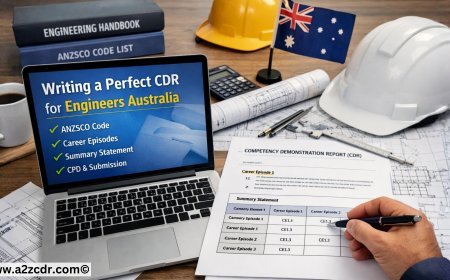








How to Format & Structure Your CDR Report Professionally
Learn how to format and structure your CDR report professionally for Engineers Australia. Avoid rejection with expert tips on Career Episodes, CPD, and Summary Statements.


Table of Contents
- Introduction
- Understanding the Importance of Proper CDR Structure
- Components of a Properly Structured CDR Report
- Formatting Your Continuing Professional Development (CPD)
- Structuring Career Episodes Correctly
- Maintaining Consistency Across Career Episodes
- Formatting the Summary Statement Correctly
- Professional CV Formatting for CDR Submission
- Language, Tone, and Presentation Standards
- File Naming and Submission Guidelines
- Common Formatting Mistakes to Avoid
- Why Professional Formatting Improves Assessment Outcomes
- Professional Assistance for Structuring Your CDR
- Conclusion
-
Introduction
Preparing a Competency Demonstration Report (CDR) is one of the most critical steps in the Engineers Australia migration skill assessment process. While many engineers focus heavily on technical content, an equally important factor that often determines success or rejection is how well the CDR is formatted and structured. Engineers Australia expects a clear, logical, and professional presentation that aligns strictly with its guidelines. Even a technically strong CDR can face delays or rejection if it is poorly structured, inconsistently formatted, or difficult to assess.
This article provides a comprehensive guide on how to professionally format and structure your CDR report so that it meets Engineers Australia’s expectations and presents your engineering competencies in the clearest possible manner.
-
Understanding the Importance of Proper CDR Structure
Engineers Australia assesses hundreds of CDR applications every month. Assessors follow a standardized evaluation framework, which means they rely heavily on consistency, clarity, and proper referencing. A well-structured CDR allows assessors to quickly identify whether you meet the required competency elements for your nominated occupation.
A poorly structured report, on the other hand, can create confusion, make competency mapping difficult, and raise doubts about professionalism. Formatting errors, missing sections, or unclear headings may lead to requests for additional information or even a negative assessment outcome. Professional structure demonstrates your ability to communicate engineering information clearly, which is itself a core competency expected of engineers in Australia.
-
Components of a Properly Structured CDR Report
A complete CDR report consists of several mandatory documents. Each document has a defined purpose and must be presented in the correct order and format. Engineers Australia strictly evaluates the following components as a single, cohesive submission. The key components include Continuing Professional Development (CPD), three Career Episodes, a Summary Statement, and a Curriculum Vitae (CV). Each document must be prepared separately but structured to support the same ANZSCO occupation and competency standards.
-
Formatting Your Continuing Professional Development (CPD)
The CPD section is often underestimated, but it plays a vital role in demonstrating your commitment to professional growth. Engineers Australia expects CPD to be concise, factual, and directly relevant to your engineering discipline. Your CPD should be formatted as a simple list presented in tabular or structured format. It should include the title of the activity, the date or duration, and the nature of learning. Activities may include workshops, seminars, certifications, technical training, conferences, self-study, and professional courses.
The language used in CPD should be neutral and descriptive. Avoid explanations, reflections, or outcomes in this section. Engineers Australia does not assess CPD depth here; they assess relevance and consistency with your claimed competencies. A professionally formatted CPD document reinforces the credibility of your Career Episodes and Summary Statement.
-
Structuring Career Episodes Correctly
Career Episodes are the most important part of your CDR and must follow a strict structure. Engineers Australia requires each Career Episode to be written as a narrative in the first-person singular, focusing entirely on your personal engineering contribution. Each Career Episode must be divided into four clearly labeled sections: Introduction, Background, Personal Engineering Activity, and Summary.
Career Episode Introduction
The introduction sets the context for the episode. It should clearly state the project title, duration, location, organization, and your role. This section should be brief and factual, providing assessors with an overview of what the episode will cover. Avoid technical explanations here. The purpose of the introduction is orientation, not demonstration of skills.
Career Episode Background
The background section explains the project environment. This includes the nature of the organization, the project objectives, and your position within the organizational structure. You may include an organization chart to show reporting relationships, but it should be simple and relevant. This section establishes the complexity and relevance of the project. It should explain why the project was undertaken and how it relates to engineering practice.
Personal Engineering Activity
This is the core of the Career Episode and should be the most detailed section. Engineers Australia focuses heavily on this part to assess competency. The narrative must explain what you personally did, how you did it, and why you made specific engineering decisions. Your writing should demonstrate problem identification, analysis, design, implementation, testing, and evaluation. Use clear engineering terminology, calculations where applicable, and technical reasoning. The emphasis must remain on your individual role, not the team’s achievements. Paragraph numbering is essential in this section. Each paragraph should be uniquely numbered, as these numbers will later be referenced in the Summary Statement.
Career Episode Summary
The summary concludes the episode by briefly restating the outcomes and your engineering contribution. It should not introduce new information. Instead, it should reinforce how the episode demonstrates your professional competence. This section should be concise and reflective without being repetitive.
-
Maintaining Consistency Across Career Episodes
All three Career Episodes must follow the same formatting style. Inconsistent headings, paragraph numbering styles, or writing tone can signal lack of attention to detail. Engineers Australia values consistency because it reflects professional documentation standards. Each episode should showcase different projects or aspects of your engineering experience, but the formatting and structure should remain identical.
-
Formatting the Summary Statement Correctly
The Summary Statement is a mapping document that links your Career Episodes to Engineers Australia’s competency elements. It is not a narrative document and must follow the exact format provided by Engineers Australia for your occupational category. Each competency element must be addressed individually, with references to specific paragraph numbers from your Career Episodes. The formatting should be clean, precise, and free of explanations beyond the required mapping.
Any mismatch between paragraph numbers or missing references can result in assessment delays or rejection. This makes accuracy and formatting especially critical.
-
Professional CV Formatting for CDR Submission
Your Curriculum Vitae should be professional, clear, and factual. Engineers Australia prefers a reverse chronological format that highlights your engineering roles, responsibilities, and achievements. Avoid decorative designs, graphics, or overly stylized layouts. The CV should support your Career Episodes by confirming employment dates, job titles, and responsibilities. Consistency between your CV, Career Episodes, and Summary Statement is essential. Any discrepancy can raise questions about credibility.
-
Language, Tone, and Presentation Standards
Engineers Australia expects all CDR documents to be written in formal English with a professional tone. Informal language, conversational phrases, or excessive technical jargon without explanation should be avoided. Clarity is more important than complexity. Well-structured sentences, logical flow, and clear explanations demonstrate communication competency, which is a core assessment criterion. Spelling, grammar, and punctuation errors can negatively impact your assessment. Proofreading is not optional; it is a requirement.
-
File Naming and Submission Guidelines
Each CDR document must be saved and uploaded as a separate PDF file using clear and consistent naming conventions. Improper file names or merged documents can cause confusion during assessment. Ensure that all documents are complete, correctly labeled, and uploaded under the appropriate sections in the Engineers Australia portal.
-
Common Formatting Mistakes to Avoid
Many applicants face rejection due to avoidable formatting and structural errors. These include missing section headings, incorrect paragraph numbering, mixing team achievements with personal contributions, inconsistent formatting across documents, and incorrect Summary Statement mapping. Plagiarism is another critical issue. Engineers Australia uses advanced plagiarism detection systems. Even unintentional similarities can lead to severe penalties. All content must be original and personalized.
-
Why Professional Formatting Improves Assessment Outcomes
A professionally formatted CDR makes the assessor’s job easier. When competencies are clearly demonstrated, properly mapped, and consistently presented, assessors can evaluate your application efficiently and confidently. Professional structure reflects your ability to prepare formal engineering documentation, which is a fundamental expectation of engineers working in Australia.
-
Professional Assistance for Structuring Your CDR
Many engineers find it challenging to balance technical accuracy with strict formatting requirements. Professional CDR writing services, such as A2Z CDR Writing Services, help engineers structure and format their CDRs exactly as Engineers Australia requires. Expert guidance ensures that your Career Episodes are well-organized, your Summary Statement is accurately mapped, and your entire submission meets professional standards. This significantly improves the likelihood of a positive skill assessment outcome.
-
Conclusion
Formatting and structuring your CDR professionally is just as important as the technical content it contains. Engineers Australia evaluates clarity, consistency, and compliance with guidelines alongside engineering competency. A well-structured CDR reflects professionalism, attention to detail, and strong communication skills.
By following the correct structure for CPD, Career Episodes, Summary Statement, and CV, maintaining consistency throughout your documents, and adhering strictly to Engineers Australia’s formatting guidelines, you can present your skills confidently and increase your chances of a successful assessment.
What's Your Reaction?
 Like
0
Like
0
 Dislike
0
Dislike
0
 Love
0
Love
0
 Funny
0
Funny
0
 Angry
0
Angry
0
 Sad
0
Sad
0
 Wow
0
Wow
0