











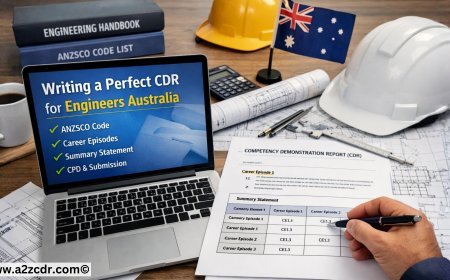








How to Write a CDR for Civil Engineers for Engineers Australia
Learn how to write a strong CDR for Civil Engineers, including Career Episodes, CPD, and Summary Statement to meet Engineers Australia’s skill assessment requirements.


For civil engineers aspiring to build a career in Australia, the Competency Demonstration Report (CDR) is one of the most crucial documents in the migration process. Engineers Australia (EA), the authority responsible for assessing engineering skills, relies heavily on a well-prepared CDR to determine whether an applicant possesses the technical capability, problem-solving expertise, and practical experience required in the Australian engineering environment.
Writing a CDR is not merely about describing your engineering tasks. It is a highly structured, competency-driven document that must clearly demonstrate your engineering knowledge, technical skills, leadership qualities, and ability to apply engineering principles to real-world problems. For civil engineers—whose roles often involve planning, designing, supervising, and managing complex infrastructure—this becomes even more important.
A compelling CDR is one that tells your engineering story clearly, logically, and professionally. It should highlight your contributions in projects such as roads, bridges, buildings, water systems, foundations, transportation networks, and structural designs. The goal is to showcase how you, as an individual engineer, made a measurable impact.
This guide provides a complete, step-by-step understanding of how civil engineers can create a strong CDR that aligns with Engineers Australia’s expectations and standards.
Understanding What a CDR Means for Civil Engineers


Before starting your report, it is essential to understand why Engineers Australia relies on CDRs. Unlike degree-recognised countries, engineers from non-accredited qualifications are assessed based on competencies, not only education. EA looks for specific engineering behaviours, technical skills, communication abilities, and problem-solving techniques displayed through your real experiences.
Civil engineering covers multiple domains—structural, geotechnical, transportation, water resources, environmental, and construction management. Therefore, EA expects your CDR to reflect your expertise in your chosen area while also demonstrating the broad capabilities expected from all civil engineers.
A complete CDR includes three main components:
-
Continuing Professional Development (CPD)
-
Three Career Episodes (CE1, CE2, CE3)
-
Summary Statement
Each part plays a unique role in presenting your engineering knowledge and experience. The CDR must be written strictly in your own words to avoid plagiarism, and your responsibilities should be supported with verifiable evidence.


How to Prepare an Effective CPD for Civil Engineering
The CPD section gives Engineers Australia a quick snapshot of how you have upgraded your engineering knowledge after graduation. Civil engineering is a continuously evolving field, with advancements in design software, environmental standards, construction methods, and regulatory frameworks. Your CPD should reflect that you have kept up with the latest tools, techniques, and industry updates.
This section does not need to be lengthy, but it must be comprehensive enough to show constant learning. Include formal courses, workshops, safety trainings, site induction programs, seminars, webinars, conferences, software trainings, or even self-guided learning sessions related to civil engineering tools such as AutoCAD, STAAD Pro, ETABS, Civil 3D, SAP2000, or project management tools.
The CPD serves as the foundation of your professional development and establishes your readiness to work in Australia’s engineering industry.
Writing Strong Career Episodes as a Civil Engineer
Career Episodes are the backbone of your CDR. Each episode represents a real engineering project or task where you played a significant role. EA wants to understand not just what the project was but what you personally did—your actions, decisions, calculations, technical contributions, and results.
Civil engineering projects tend to be complex and multidisciplinary. This gives applicants an excellent opportunity to demonstrate wide-ranging competencies—from structural analysis and site supervision to problem-solving during construction or design challenges.
Choosing the Right Projects
Select three different projects that highlight different capabilities. For example:
-
A structural design project involving load calculations
-
A site supervision or quality control task at a construction site
-
A water or transportation engineering project involving planning and analysis
Avoid selecting three similar projects; variety helps demonstrate a wider skill set.
Storytelling Approach for Each Career Episode
Each Career Episode should be written as a narrative, not bullet points. You should describe the project situation, your role, the tasks assigned, and the actions you took. Engineers Australia is primarily interested in your personal contribution, so use “I” statements (e.g., "I designed", "I analyzed", "I inspected").
Focus on describing how you approached engineering problems—how you assessed loads, selected materials, complied with standards, ensured safety, managed risks, performed calculations, coordinated with teams, or conducted site inspections.
You should also describe the challenges you encountered and the solutions you applied. For example, perhaps you had to modify a foundation design due to unexpected soil conditions, optimize a drainage design to reduce environmental impact, or resolve construction delays through better planning.
Civil engineering projects often involve safety, sustainability, environmental considerations, and cost management—include these where applicable. These elements help demonstrate your professional maturity.
Key Areas Engineers Australia Looks for in Civil Engineering CDRs
Engineers Australia has a specific competency standard for civil engineers, and your Career Episodes should reflect these competencies naturally through your experiences.
Technical Engineering Knowledge
Your episodes should clearly show that you understand engineering principles such as:
-
Structural mechanics
-
Hydraulics and hydrology
-
Soil and foundation engineering
-
Road and transportation design
-
Surveying principles
-
Concrete and steel design
-
Construction methods and planning
Explain the tools and methods you used and why they were suitable.
Application of Engineering Techniques
Show how you applied engineering principles to achieve results. For example, when designing a structural element, explain how you calculated loads, selected materials, ensured compliance with codes, and validated safety factors.
When describing construction supervision, mention how you monitored site activities, ensured quality control, addressed design discrepancies, or managed coordination between contractors.
Use of Engineering Software
Civil engineers are expected to be proficient with software tools. Describe how you used applications like:
-
AutoCAD for drafting
-
STAAD Pro or ETABS for structural analysis
-
Civil 3D for road or site design
-
MS Project or Primavera for planning
-
Revit for BIM modeling
Explain how the software helped improve accuracy, efficiency, or project outcomes.
Problem-Solving Abilities
Civil engineering often involves unexpected challenges—soil instability, safety hazards, design conflicts, or environmental constraints. Demonstrate how you analyzed the situation, evaluated options, and implemented effective solutions.
Communication and Coordination
Civil engineers frequently collaborate with architects, contractors, surveyors, suppliers, and clients. Show how you communicated technical information, resolved site issues, conducted meetings, prepared reports, or coordinated with multiple teams.
Writing an Effective Summary Statement
The Summary Statement is one of the most important sections of your CDR. It highlights how your Career Episodes meet the competency elements required by Engineers Australia.
This part is highly technical because each paragraph of your Career Episodes must be mapped to the specific competency elements of EA’s Migration Skills Assessment (MSA) booklet. The Summary Statement is a matrix where you explain exactly where in the episodes you demonstrated each competency.
Civil engineers are expected to demonstrate competencies in:
-
Knowledge and Skill Base
-
Engineering Application Ability
-
Professional and Personal Attributes
Writing a Summary Statement takes careful interpretation and mapping. Many applicants find this section challenging because it requires understanding the competency descriptions thoroughly. Ensure that your summary is accurate, logical, and well-aligned with the content of your episodes.
Common Mistakes Civil Engineers Must Avoid in CDR Writing
Many CDRs get rejected because of avoidable errors. Civil engineering applicants often fall into the trap of writing tasks instead of engineering contributions. Avoid generic descriptions like “I assisted,” “I helped,” or “We completed.” Engineers Australia wants to know what you did, not what the team achieved.
Plagiarism is another major issue. Copying content from sample CDRs or using template descriptions is strictly prohibited. EA uses advanced plagiarism detection tools, and even partially copied content may lead to immediate rejection or a ban.
Another mistake is writing overly technical reports without clear storytelling. A good CDR strikes a balance between technical details and readable narrative. You must also ensure all drawings, calculations, and technical discussions are explained clearly but concisely.
Tips for Civil Engineers to Strengthen Their CDR
Civil engineers can significantly improve their chances of approval by following some simple but effective strategies. A well-organized CDR that narrates real, significant experiences showcases your capability better than a long, complex report. Include measurable impacts where possible—such as cost savings achieved, construction delays avoided, or structural efficiency improvements.
Demonstrating knowledge of engineering standards, safety regulations, and best practices also helps establish credibility. If you have experience working with ISO standards, building codes, Eurocodes, ACI standards, or local engineering authorities, include these details in your narratives.
Using active voice, first-person statements, and impactful vocabulary helps make your engineering story engaging and meaningful. Remember, Engineers Australia is evaluating your competence, decision-making ability, and personal involvement—not simply your job history.
Why Professional CDR Help Can Improve Your Chances
Civil engineering projects are complex, and presenting your experience in a structured, EA-compliant format can be challenging. Many engineers know their work well but struggle to convert it into a narrative that meets the Migration Skills Assessment criteria. Professional CDR experts understand EA guidelines, competency requirements, formatting standards, and storytelling techniques that can help make your CDR stand out.
They can help refine your Career Episodes, map competencies accurately in your Summary Statement, and ensure your CPD is professionally presented. Most importantly, they ensure your content is unique, plagiarism-free, and aligned with your actual experience.
Preparing a strong CDR is an essential step for civil engineers aiming to migrate to Australia. It requires clarity, accuracy, and a deep understanding of how to present your engineering journey in line with Engineers Australia’s standards. The best CDRs are those that demonstrate real engineering capability—technical knowledge, problem-solving ability, leadership, communication skills, and practical experience across diverse projects.
Civil engineers who invest the right time, focus, and strategy in crafting their CDR significantly increase their chances of a positive assessment. If done correctly, your CDR becomes a powerful reflection of your engineering expertise and opens doors to a successful engineering career in Australia.
What's Your Reaction?
 Like
0
Like
0
 Dislike
0
Dislike
0
 Love
0
Love
0
 Funny
0
Funny
0
 Angry
0
Angry
0
 Sad
0
Sad
0
 Wow
0
Wow
0