












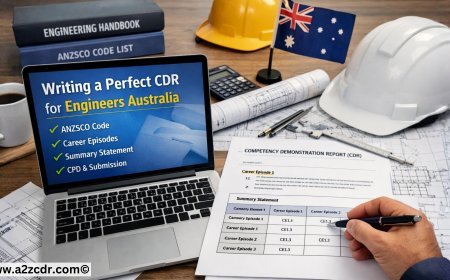








Ultimate CDR Guide for Electrical Engineers: Avoid Rejection & Impress EA
Create a successful Electrical Engineer CDR with expert tips, real examples, and clear guidelines to meet Engineers Australia standards and achieve a positive MSA outcome.


Electrical Engineers’ CDR: Tips, Examples, and Guidelines
Preparing a Competency Demonstration Report (CDR) as an Electrical Engineer is one of the most important steps in securing a successful Migration Skill Assessment from Engineers Australia. For many applicants, the CDR becomes a challenging task—not because they lack engineering skills, but because they struggle to express those skills in a structured, evidence-based, and competency-focused format. Electrical engineering is a diverse and technically complex discipline, and Engineers Australia expects applicants to clearly demonstrate their understanding of electrical systems, engineering theory, design principles, analytical problem-solving, and professional judgment.
A well-written CDR for Electrical Engineers should reflect your experience in designing, developing, evaluating, installing, and maintaining electrical systems and components. Whether you’ve worked in power systems, control systems, automation, instrumentation, renewable energy, electronics, telecommunications, or industrial electrical engineering, your CDR must show how you applied engineering knowledge to real projects. This article explains everything you need to know about writing a strong Electrical Engineer CDR—including guidelines, examples, and essential tips to help you achieve a positive assessment outcome.
Understanding What Engineers Australia Expects from Electrical Engineers
The ANZSCO code for Electrical Engineer is 233311, and it outlines a detailed list of responsibilities and competencies expected from professionals in this field. Engineers Australia uses these descriptions to evaluate whether your engineering experience aligns with the role. The occupational description includes designing electrical equipment, developing electrical installation procedures, analyzing test data, overseeing projects, implementing safety protocols, and solving complex engineering problems related to electrical systems.
When assessing your CDR, Engineers Australia wants to see evidence of how you contribute to engineering activities in areas such as power generation, transmission, distribution, protection systems, power electronics, control systems, instrumentation, SCADA, energy efficiency, and automation projects. They evaluate your ability to apply mathematical models, electrical engineering theories, simulation tools, and industry standards. They also want to see whether you have engaged in technical leadership, design verification, system troubleshooting, testing, risk assessments, and compliance with electrical regulations.


Your CDR must demonstrate these competencies through real-life examples—your actual engineering work—not theoretical explanations or generalized responsibilities. This is where many applicants go wrong, as they focus on job descriptions rather than describing their personal contribution to engineering tasks.
Writing Effective Career Episodes for Electrical Engineers
Career Episodes are the core of your CDR, and each episode must highlight a specific engineering project or task you performed. These episodes must be written in the first person and should clearly describe your role in the project, the engineering issues you handled, the technical decisions you made, and the results you achieved.
When writing Career Episodes as an Electrical Engineer, you should choose projects that best reflect your engineering expertise. Examples may include electrical system design, power distribution projects, control panel design, protection system implementation, PLC automation tasks, or troubleshooting activities in an industrial or commercial environment.
A strong episode should be structured like a narrative. Instead of listing tasks, you should explain how you approached the project, what methodology you applied, what tools you used, and what engineering challenges you solved. Engineers Australia evaluates your ability to work independently, apply standards, create designs, conduct calculations, and ensure safety compliance. Therefore, your episodes must show not just what you did, but how and why you did it.
For example, if you describe a project involving the design of an electrical distribution board, you should explain the load calculations you performed, how you selected protective devices, how you applied electrical codes, and how you tested the system. The more technically detailed and personalized your episodes are, the stronger your CDR will be.
Examples of Strong Engineering Narratives for Electrical Engineers


To help you visualize how to present your work, consider a scenario in which you designed a power distribution system for an industrial facility. Instead of simply saying that you “designed the electrical layout,” you would describe how you performed demand calculations based on load requirements, how you selected cable sizes using voltage drop and current carrying capacity criteria, how you modeled the system using simulation tools such as ETAP or MATLAB, and how you ensured compliance with electrical safety standards.
Another example could involve the installation and commissioning of a programmable logic controller (PLC) system. Instead of writing that you “configured PLCs,” describe how you developed ladder logic, implemented safety interlocks, integrated sensors, configured actuators, and tested the functionality of the control sequence. This level of detail shows Engineers Australia that you were directly responsible for the engineering decisions that contributed to the successful outcome of the project.
Similarly, if you worked on a renewable energy project, such as a solar power installation, explain the steps you took to design the system—such as analyzing irradiance data, selecting inverters, designing the array configuration, evaluating grid integration requirements, and conducting efficiency analysis. These details make your CDR authentic, technically sound, and relevant to the Electrical Engineer occupation.
Demonstrating Key Electrical Engineering Competencies
Engineers Australia evaluates applicants based on the Stage 1 competency elements, which include knowledge application, problem-solving, engineering design, risk management, project management, communication, and professional conduct. As an Electrical Engineer, your CDR must reflect how you applied these competencies in real-world situations.
Your episodes should show that you understand advanced electrical engineering concepts such as system stability, harmonics, grounding, protection coordination, and network analysis. They must also demonstrate your ability to use engineering tools like AutoCAD Electrical, ETAP, Power World Simulator, MATLAB, LabVIEW, SCADA systems, and other industry-standard software.
You should also highlight how you ensured safety compliance and followed relevant electrical standards, such as IEC, NEC, IEEE regulations, or country-specific electrical codes. Engineers Australia places strong emphasis on ethical practice and safety considerations, so including examples of risk assessments, safety inspections, incident prevention measures, or compliance checks will strengthen your CDR significantly.
Structuring Your Career Episodes Effectively
Although Career Episodes should not be written in point form, they must follow a logical structure. Engineers Australia expects each episode to include an introduction, background, personal engineering activity, and conclusion. The introduction briefly outlines the project timeframe, your role, and the employer. The background describes the project context, objectives, and your duties. The main engineering activity section focuses on the technical work you performed, and the conclusion summarizes your achievements.
For Electrical Engineers, the engineering activity section is the most important part. This is where you must explain your calculations, design decisions, analytical approaches, testing procedures, engineering reasoning, and problem-solving techniques. Avoid describing what the team did; instead, emphasize your own contribution. Using “I” statements ensures that Engineers Australia can clearly identify your involvement.
Crafting a Strong Summary Statement
The Summary Statement links your Career Episodes to the competency elements required by Engineers Australia. It is one of the most challenging parts of the CDR because it requires a deep understanding of competency standards and careful mapping of your engineering activities.
For Electrical Engineers, the Summary Statement must highlight your ability to apply electrical engineering theories, evaluate complex problems, design and analyze electrical systems, ensure compliance with safety requirements, and communicate technical information effectively. Engineers Australia wants to see how your Career Episodes demonstrate these competencies. Therefore, your Summary Statement should reference specific paragraphs in your episodes that show evidence of your engineering knowledge, creativity, leadership, and professional integrity.
Presenting an Impressive CPD List
Your Continuing Professional Development (CPD) document must show that you engage in ongoing learning and stay updated with electrical engineering advancements. This may include training programs, certifications, workshops, conferences, online courses, technical meetings, and reading activities.
Electrical Engineers should highlight CPD activities related to renewable energy systems, electrical safety regulations, automation, power system analysis, SCADA operations, energy efficiency, protection systems, and engineering software tools. Your CPD does not need to be lengthy, but it must show consistency and relevance to your profession.
Why Many Electrical Engineer CDRs Get Rejected
Rejections occur when applicants fail to demonstrate personal contributions, provide technical details, follow CDR formatting guidelines, or match their Career Episodes to their chosen ANZSCO code. Electrical Engineers often make the mistake of describing general job responsibilities instead of engineering achievements, which results in insufficient evidence of competency.
Plagiarism is another major issue. Engineers Australia uses advanced software to detect copied content, and any duplication—even unintentional—can lead to rejection. Many engineers also fail to align their episodes with electrical engineering tasks, causing the competency assessment to fall short.
How A2Z CDR Writing Services Helps Electrical Engineers
Electrical engineering is a highly technical field, and preparing a CDR that meets Engineers Australia’s expectations can be overwhelming. A2Z CDR Writing Services assists applicants by reviewing their experience, selecting strong projects, preparing technically accurate Career Episodes, drafting a concise Summary Statement, and ensuring the entire document aligns with EA guidelines.
Our experienced engineering writers understand ANZSCO requirements, EA’s Stage 1 competencies, and occupational standards for Electrical Engineers. We help engineers worldwide secure positive migration skill assessments by creating professional, plagiarism-free, competency-based CDR reports tailored to each applicant’s background.
What's Your Reaction?
 Like
0
Like
0
 Dislike
0
Dislike
0
 Love
0
Love
0
 Funny
0
Funny
0
 Angry
0
Angry
0
 Sad
0
Sad
0
 Wow
0
Wow
0