












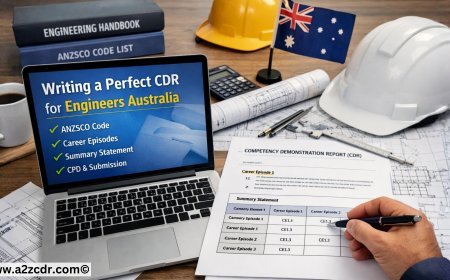








The Role of Career Episodes in Demonstrating Your Engineering Skills
Learn how Career Episodes strengthen your CDR by showcasing your engineering skills, technical abilities, and competencies for a successful Engineers Australia assessment.


For engineers applying for skilled migration to Australia, the Competency Demonstration Report (CDR) is the most crucial document required by Engineers Australia (EA). Among all components of the CDR—Career Episodes, Summary Statement, and Continuing Professional Development—it is the Career Episodes that truly define your professional identity. They narrate your engineering journey, highlight your technical abilities, and reveal your personal role in real-world engineering tasks.
Career Episodes are not simple project summaries. They are detailed, reflective, and analytical narratives that allow Engineers Australia to understand how you think as an engineer, how you solve problems, and how you contribute to engineering outcomes. Through them, EA evaluates whether your knowledge and experience match the standards required for the engineering occupation you are applying for.
This article explores the deeper importance of Career Episodes, explains how they showcase your skills, and guides you on why they are central to a successful CDR application.
What Are Career Episodes?
Career Episodes are structured written narratives that describe three significant engineering experiences from your academic, internship, or professional life. They are written in the first person to emphasize your individual involvement. Each episode focuses on a specific engineering project, task, assignment, or technical challenge that demonstrates your competencies in a clear and measurable manner.


Unlike a résumé, which simply lists responsibilities and job titles, Career Episodes tell a story. They allow EA to understand the context of your work: what the project was about, what you were responsible for, what challenges you faced, what engineering methods you applied, and what results you achieved. These episodes provide depth, clarity, and authenticity to your professional capabilities.
Why Career Episodes Matter for Your CDR
The importance of Career Episodes lies in their ability to reflect your engineering competencies in a practical, relatable, and verifiable way. Engineers Australia does not assess your suitability for migration by only looking at your qualifications. They need evidence that you have applied engineering principles, made decisions, solved problems, and contributed meaningfully to projects. Career Episodes give them that evidence.
They illustrate how you think as an engineer, how you evaluate risks, how you interact with teams, and how you align your work with engineering standards. If your Career Episodes are not well-written, lack personal involvement, or fail to provide sufficient technical details, EA cannot properly assess your competencies. Therefore, the quality and authenticity of your Career Episodes directly influence the outcome of your skills assessment.
How Career Episodes Demonstrate Your Engineering Skills
Career Episodes give you the opportunity to highlight your engineering skills through real-life examples. Instead of stating that you know how to design a system, perform an analysis, or supervise a team, you prove it by narrating when and how you actually performed those tasks.
They showcase your ability to apply theoretical knowledge in practical situations. Through them, EA can see how you conduct calculations, design components, run simulations, troubleshoot systems, interpret technical data, implement safety measures, and follow standards. They allow you to describe your engineering mindset—your decision-making, analytical thinking, and problem-solving capabilities.


Moreover, Career Episodes highlight your individual contribution. Instead of focusing on what the entire team achieved, you describe what you specifically did. This distinction is crucial because Engineers Australia evaluates individual competence, not collective success. Your narrative must clearly outline your personal responsibilities, challenges, and achievements.
Career Episodes also demonstrate the alignment between your experience and your chosen ANZSCO occupation. For example, if you apply as a Mechanical Engineer, the episodes you present should reflect mechanical engineering concepts. Similarly, civil, electrical, industrial, and chemical engineers must showcase competencies relevant to their respective fields. EA uses your Career Episodes to determine whether your experience matches the engineering category you are applying for.
The Required Structure of a Career Episode
Although Career Episodes focus on narrative storytelling, they must follow a structured format prescribed by Engineers Australia. This structure includes four key sections: Introduction, Background, Personal Engineering Activity, and Summary.
The Introduction briefly outlines when and where the episode took place, the name of the project, and your designation or position. It offers a snapshot of the engineering experience you are about to describe.
The Background then explains the context of the project. This includes the objectives, the nature of the work, your responsibilities, and the environment in which the project was carried out. It gives EA a clear picture of why the project was important and what role you played in it.
The Personal Engineering Activity section is the most significant part of the episode. This is where you describe your actions, decisions, and contributions. You focus on the engineering techniques you used, the problems you solved, the reasoning behind your decisions, and the outcomes you achieved. Everything in this section must reflect your competence as an engineer. This is where EA finds the evidence needed to evaluate you.
Finally, the Summary provides a short reflection on the overall outcome of the project, the contribution you made, and what you learned from the experience. It wraps up the episode by reinforcing your engineering capabilities.
Why Technical Depth Is Essential in Career Episodes
Career Episodes must be rich in technical content. Simply describing your responsibilities or daily tasks is not enough. Engineers Australia looks for specific engineering actions, such as calculations, design procedures, analytical methods, software usage, safety or compliance measures, and key decisions that influenced the project.
Your narrative should clearly explain the problem you faced and how you solved it. For example, if you designed a system, describe the steps you took, the standards you followed, the formulas you used, and the constraints you addressed. If you performed simulations, mention the software, input parameters, and results analysis.
This level of technical detail gives your Career Episodes credibility and shows EA that you genuinely understand and perform engineering tasks at a professional level.
Demonstrating Leadership and Communication Skills
Engineering is not only about technical expertise. Effective engineers coordinate teams, communicate with stakeholders, manage timelines, and resolve conflicts. Career Episodes offer a perfect opportunity to demonstrate these skills.
You can explain how you guided junior engineers, collaborated with colleagues from different departments, communicated project requirements, or led meetings with clients or contractors. You can describe how you handled issues, delegated tasks, and ensured project completion.
Leadership and communication are part of the competencies EA evaluates, and your Career Episodes allow you to showcase them naturally within the narrative.
Showing Compliance With Standards and Safety Practices
One of the most important aspects of engineering practice is compliance with professional standards, safety regulations, and industry codes. Engineers Australia expects applicants to demonstrate that they understand and follow these standards in their work.
Your Career Episodes should explain the standards you adhered to—whether they were Australian Standards, ISO codes, IEC guidelines, IEEE regulations, AISC codes, or any relevant industry practices. You should describe how you applied these standards in your designs, analyses, testing, or implementation work.
In addition to standards, safety practices must also be highlighted. Engineers are responsible for the safety of the systems they design. If your project involved risk assessment, hazard identification, safety audits, or compliance checks, describe them clearly in your narrative.
Avoiding Common Mistakes in Career Episodes
Many applicants face CDR rejection because of avoidable errors in their Career Episodes. One of the most common mistakes is writing in the third person. Since EA evaluates your personal competency, the narrative must focus on your actions. Use “I designed,” “I calculated,” “I analyzed,” and “I supervised” rather than “we” or “the team.”
Another frequent issue is the lack of technical depth. Vague descriptions fail to demonstrate engineering competency. Your narrative must include details that show your technical knowledge and decision-making.
Plagiarism is another serious problem. Engineers Australia uses powerful plagiarism-detection tools, and any copied content can lead to rejection or suspension. Your Career Episodes must be completely original and written in your own words.
Finally, avoid overly theoretical explanations. Career Episodes should reflect practical application, not textbook descriptions. Focus on real engineering work, not general concepts.
Selecting the Right Projects for Your Career Episodes
Not every project from your career will be suitable for a Career Episode. You should select experiences that highlight a variety of competencies and align with your chosen ANZSCO occupation. Ideally, each episode should cover a different aspect of your expertise—design, analysis, project management, or technical problem-solving.
Choose projects where you had significant responsibility or made meaningful contributions. Projects where you were minimally involved or only performed routine tasks may not effectively demonstrate your engineering skills.
Also, choose projects that allow you to showcase different competencies required for your engineering category. For example, if you are applying as a Civil Engineer, choose projects related to structural analysis, design, geotechnical work, or infrastructure development. Electrical engineers should select projects involving power distribution, control systems, protection systems, or automation. Mechanical engineers should focus on design, HVAC, machinery, production, or thermodynamics-related tasks. The right project selection ensures your Career Episodes provide a comprehensive view of your engineering capabilities.
Why Career Episodes Form the Basis of Your Summary Statement
Your Summary Statement maps specific elements of EA’s competency standards to the content in your Career Episodes. This mapping requires clear, structured, and detailed information from your episodes. Without strong Career Episodes, the Summary Statement becomes weak or incomplete.
Every competency listed in the Summary Statement must link to a specific paragraph in one or more Career Episodes. If the episodes do not describe relevant actions, you cannot prove competency. Therefore, Career Episodes are the foundation on which your Summary Statement is built.
Career Episodes are one of the most important parts of the CDR because they offer a real, transparent view of your engineering skills, technical knowledge, leadership abilities, and professional maturity. They allow Engineers Australia to understand not just what you know, but how you apply that knowledge in real situations.
By focusing on personal involvement, technical detail, proper structure, and relevant engineering competencies, your Career Episodes can effectively demonstrate your suitability for the engineering occupation you are applying for.
A strong set of Career Episodes increases your chances of success in your CDR assessment and brings you a step closer to achieving your dream of becoming a recognized engineer in Australia.
What's Your Reaction?
 Like
0
Like
0
 Dislike
0
Dislike
0
 Love
0
Love
0
 Funny
0
Funny
0
 Angry
0
Angry
0
 Sad
0
Sad
0
 Wow
0
Wow
0