











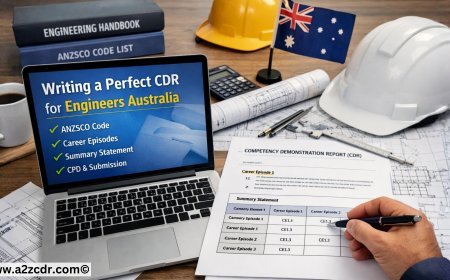







Key Words and Technical Terms That Make Your CDR Stand Out
Learn how using the right technical keywords can strengthen your CDR, align with Engineers Australia competencies, and improve your migration skill assessment.


Introduction: The Importance of Keywords in Your CDR
Writing a Competency Demonstration Report (CDR) for Engineers Australia is a crucial step for engineers seeking skilled migration to Australia. The CDR is more than a simple report of your work history; it is a document that demonstrates your engineering competencies and professional capabilities. To stand out, your CDR must be written in a professional manner, using precise technical terms and keywords that clearly illustrate your expertise and align with the expectations of Engineers Australia. Many applicants make the mistake of using generic language or vague descriptions, which can lead to delays, requests for additional information, or even rejection of their Migration Skill Assessment (MSA).
A strong CDR should effectively communicate your technical knowledge, problem-solving abilities, project management skills, and practical engineering experience. Engineers Australia assesses your CDR based on your Career Episodes, Summary Statement, and Continuing Professional Development (CPD), and the use of appropriate technical terminology is critical to ensure that your competencies are easily identifiable. Keywords and technical terms demonstrate that you have an in-depth understanding of your engineering field and that your work is consistent with industry standards.
Understanding the Role of Technical Terms
Understanding the role of keywords in your CDR is essential. The language you use should not only describe your work but also reflect the level of responsibility and complexity of the tasks you performed. Technical terms help the assessor recognize your proficiency in specific areas such as system design, structural analysis, signal processing, process optimization, project management, and other field-specific skills. Generic phrases like “worked on projects” or “completed tasks” fail to convey the depth of your expertise. Instead, using terminology such as “finite element analysis,” “circuit simulation,” or “load-bearing analysis” shows that you possess the necessary technical knowledge and practical experience.
Linking Keywords to Competencies
Engineers Australia evaluates your CDR under several core competencies, including PE1 (Knowledge and Skill Base), PE2 (Engineering Application Ability), and PE3 (Professional and Personal Attributes). Each of these competencies requires evidence that you have applied your knowledge effectively in professional contexts. Using the right keywords ensures that assessors can easily link your work experience to these competencies. The careful integration of technical terms into your Career Episodes, Summary Statement, and CPD allows the assessor to quickly identify your skills and understand your contribution to engineering projects.
Career Episodes: Showcasing Expertise
The most important part of the CDR where keywords and technical terms matter is the Career Episodes. These are detailed narratives of your engineering work, usually based on three major projects or professional experiences. Each Career Episode should clearly describe your role, responsibilities, the engineering challenges you faced, and the solutions you implemented. To make your Career Episodes stand out, you need to use specific technical terms related to your field of engineering. For instance, an electronics engineer should include terms such as “circuit design,” “signal processing,” “embedded systems,” or “control systems engineering.” A civil engineer should emphasize terms like “structural analysis,” “project lifecycle management,” “soil mechanics,” or “reinforced concrete design.” These terms make your work tangible and allow the assessor to appreciate the depth of your expertise.


Highlighting Engineering Design and Development Skills
In addition to field-specific technical terms, it is important to include keywords related to engineering design and development. These keywords reflect your ability to conceptualize, design, and implement engineering solutions. Terms such as “system design,” “prototype development,” “technical drawings,” and “process optimization” demonstrate that you are capable of not only completing tasks but also innovating and improving processes. Highlighting your involvement in design and development activities establishes your engineering capabilities and sets your CDR apart from generic submissions.
Demonstrating Project Management Abilities
Project management terminology is another critical category of keywords to include in your CDR. Engineers Australia values applicants who can manage tasks efficiently and demonstrate leadership in their projects. Including terms such as “project planning,” “risk assessment,” “resource allocation,” “budget estimation,” and “compliance with engineering standards” conveys your ability to manage engineering projects from conception to completion. These terms also reflect your understanding of professional responsibilities and your readiness to take on complex engineering challenges in an Australian context.
Using Technical Analysis and Problem-Solving Terms
Equally important are technical analysis and problem-solving terms. These terms highlight your analytical thinking, critical evaluation, and practical application of engineering principles. Keywords such as “load calculation,” “failure analysis,” “performance testing,” “simulation,” “modeling,” and “data analysis” demonstrate that you are capable of identifying problems, evaluating solutions, and implementing effective outcomes. Including such terms in your Career Episodes provides concrete evidence of your problem-solving abilities and reinforces your suitability for the migration skill assessment.
Showcasing Software and Tools Expertise
Another aspect that strengthens a CDR is the inclusion of software, tools, and equipment terms. Engineers must demonstrate familiarity with industry-standard tools and technology. Mentioning specific software programs such as MATLAB, AutoCAD, SolidWorks, PLC programming, or SCADA systems, as well as instrumentation and measurement devices, shows that you can apply modern engineering tools in practical scenarios. It also reflects that your skills are aligned with current engineering practices and standards, which is essential for a successful assessment.
Highlighting Professional Attributes
Professional attributes such as communication, leadership, and teamwork are equally important in your CDR. Engineers Australia evaluates PE3 competencies to ensure applicants can work effectively within teams, communicate technical information, and demonstrate ethical and professional responsibility. Keywords such as “technical report writing,” “stakeholder consultation,” “team leadership,” and “collaboration” should be incorporated throughout your Career Episodes and Summary Statement. These terms highlight your ability to convey complex technical information clearly and manage professional relationships effectively.
Aligning Keywords in the Summary Statement
Integrating keywords into your Summary Statement is just as important as using them in your Career Episodes. The Summary Statement maps the competencies claimed in your Career Episodes to Engineers Australia’s indicators. Using consistent technical terms ensures that your Summary Statement aligns with the evidence presented in your Career Episodes. This reduces ambiguity and demonstrates that you have a clear understanding of your professional competencies. It also increases the likelihood that your CDR will be assessed positively.
Avoiding Misuse of Keywords
While incorporating keywords and technical terms is important, it is equally crucial to avoid overuse or irrelevant terms. Engineers Australia can identify when terms are used inappropriately or without context. Overloading your CDR with jargon without demonstrating actual experience can negatively impact your assessment. Every keyword included must directly relate to your work experience, demonstrate your competencies, and align with your chosen ANZSCO code. Irrelevant or exaggerated claims can result in delays or even rejection.


Importance of ANZSCO Alignment
Choosing the right keywords also depends on your selected ANZSCO code. Each occupation has specific skill requirements and tasks. Your CDR should reflect the responsibilities outlined in your chosen code, and your technical terms should reinforce your alignment with that occupation. For instance, an Industrial Engineer must include terms such as “production optimization,” “workflow analysis,” and “quality control,” while an Electrical Engineer would focus on “circuit design,” “load analysis,” and “electrical network management.” This tailored approach ensures that your CDR is relevant and demonstrates a clear connection between your work experience and your occupation.
Using Keywords in CPD Records
Continuing Professional Development (CPD) records are another section where keywords and technical terms can strengthen your CDR. Listing specific workshops, courses, and certifications using proper technical terminology highlights your ongoing learning and commitment to professional growth. For example, describing a workshop as “Advanced MATLAB Programming for Signal Processing” or “Finite Element Analysis Training for Structural Design” provides clarity and demonstrates the depth of your knowledge.
Conclusion: Making Your CDR Stand Out
To summarize, the effective use of keywords and technical terms is essential for creating a CDR that stands out. These terms showcase your engineering knowledge, technical skills, and professional experience. They make your Career Episodes compelling, your Summary Statement precise, and your CPD relevant. Proper keyword integration demonstrates to Engineers Australia that you understand your field, apply industry standards, and possess the competencies required for your chosen occupation. Professional support from a service like A2Z CDR Writing Services can further enhance the quality of your CDR and improve your likelihood of migration success.
What's Your Reaction?
 Like
0
Like
0
 Dislike
0
Dislike
0
 Love
0
Love
0
 Funny
0
Funny
0
 Angry
0
Angry
0
 Sad
0
Sad
0
 Wow
0
Wow
0