











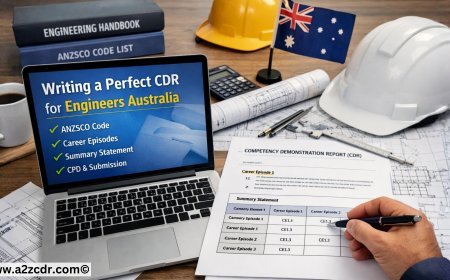








How to Perfect Your CDR for Engineers Australia: Career Episodes, Summary Statement, & CPD
A complete guide to writing successful Career Episodes, Summary Statement, and CPD for your CDR report for Engineers Australia. Boost your migration success.


For engineers aspiring to migrate to Australia, preparing a Competency Demonstration Report (CDR) is one of the most crucial and challenging steps in the Migration Skills Assessment process. Engineers Australia, the assessing authority, evaluates an applicant’s engineering knowledge, competency level, and practical experience through the CDR. This report determines whether an engineer’s skills align with Australian professional standards. Because of this, engineers must not only present themselves effectively but also ensure their report strictly follows Engineers Australia’s guidelines.
A complete CDR consists of three major components: Career Episodes, Summary Statement, and Continuing Professional Development (CPD). Each plays a unique role in showcasing your expertise and professional growth. Understanding these components in detail is essential for engineers who want their application to stand out and secure a positive outcome.
This article provides an in-depth explanation of each component, how they contribute to the overall CDR, common mistakes engineers should avoid, and how to ensure each part meets the expectations of Engineers Australia.
Understanding the Importance of the CDR Report
Before exploring the individual components, it is important to understand why the CDR holds so much significance in the migration process. Engineers Australia does not simply assess your academic background. Instead, they analyze how effectively you have applied engineering principles throughout your career. This means your report must focus on real engineering experiences, technical decisions, challenges, innovations, and contributions you made in your work environment.
The CDR becomes a personal marketing document that represents your engineering journey. If written correctly, it demonstrates that you meet the competency standards required for practicing engineering in Australia. If written poorly, it can lead to delays, requests for additional information, or even rejection. Therefore, every part of the CDR must be drafted carefully, thoughtfully, and professionally.


Career Episodes: The Core of the CDR
Career Episodes are the narrative backbone of the CDR and serve as the most detailed part of the entire report. You are required to write three separate Career Episodes, each focusing on a distinct engineering experience from your academic or professional life. These episodes provide the evidence Engineers Australia needs to assess your problem-solving abilities, technical skills, and engineering knowledge.
A Career Episode should highlight moments in your engineering journey where you played a significant role. This could be a project you completed, a task you executed independently, a technical problem you solved, or a significant engineering outcome you achieved. The goal is to demonstrate your individual contribution, not the achievements of your team or company.
Each Career Episode must be written in the first person because Engineers Australia wants to understand your participation, decisions, and responsibilities. Instead of saying “we designed the system,” it is crucial to say “I designed the system” or “I developed the calculations.” Career Episodes are not project reports or team summaries; they must reflect your personal engineering involvement.
A typical Career Episode includes four sections: Introduction, Background, Personal Engineering Activity, and Summary. While the structure provides clarity, the writing itself should flow like a narrative. Engineers Australia expects a detailed description of the engineering methods you applied, your analytical reasoning, and the outcomes of your work. Simply listing tasks or job duties is not sufficient. You must explain your thought process, technical decisions, challenges encountered, and the engineering principles you used.
One of the most common mistakes engineers make is writing Career Episodes that sound too general or theoretical. Some engineers copy content from project documents, online samples, or generic descriptions, which leads to plagiarism—a major violation in the CDR process. Engineers Australia uses advanced plagiarism detection tools, and any copied content can result in immediate rejection. Authenticity, originality, and clarity are essential in creating strong Career Episodes.
Another challenge engineers face is selecting the right experiences to write about. Ideally, each episode should highlight different skills, different challenges, and different engineering competencies. For instance, one episode could focus on design work, another on project management, and a third on technical troubleshooting or implementation. The goal is to showcase the diversity and depth of your engineering abilities.
Summary Statement: The Most Crucial Part of Your CDR

After writing the three Career Episodes, you are required to prepare a Summary Statement. This document is often considered the most complex part of the CDR because it requires a detailed mapping of your engineering competencies to specific sections of your Career Episodes.
Engineers Australia provides a competency reference template based on the engineering category you are applying for, such as Professional Engineer, Engineering Technologist, Engineering Associate, or Engineering Manager. Each category has a different set of elements and indicators of competency. The Summary Statement is your opportunity to demonstrate where and how you have fulfilled each requirement.
In the Summary Statement, you must review your Career Episodes closely and link specific paragraphs to the competency elements. This means your Career Episodes should be numbered clearly, making it easier to reference them. The Summary Statement must reflect accuracy, precision, and clarity. If the mapping is incorrect, incomplete, or vague, it may result in your application being delayed or rejected.
Unlike the Career Episodes, the Summary Statement is not a narrative. It is a structured document that summarises your competencies with evidence from the episodes. Many engineers struggle with this step because it requires not only technical understanding but also analytical thinking.
A common error is mapping the same content repeatedly to multiple competencies, which can make your application appear weak or repetitive. The Summary Statement must reflect variety, demonstrating that you have showcased multiple skills across different episodes. It is important to take time to analyze the competency standards carefully and connect each one meaningfully to your experiences.
The Summary Statement is often the deciding factor for Engineers Australia because it acts as a guide for the assessor. If done correctly, it simplifies the assessment process. If done poorly, it creates confusion and may undermine the strength of otherwise well-written Career Episodes.
Continuing Professional Development (CPD): Demonstrating Commitment to Growth
The CPD list is the simplest part of your CDR but still holds significant value. It provides a snapshot of how you have continued to enhance your engineering knowledge beyond formal education. Engineers Australia expects candidates to show ongoing learning, as engineering is a field that evolves rapidly with technological advancements, new methodologies, and emerging trends.
Your CPD may include workshops, seminars, conferences, training programs, certifications, professional courses, online learning, technical reading, and even self-study. The goal is to demonstrate your dedication to staying updated in your field.
Engineers Australia requires CPD to be listed in a simple table format that includes the activity title, date, duration, and provider. What matters most is the relevance of the activities to your engineering discipline. A well-prepared CPD list reflects your professional development journey and proves that you maintain competency through continuous learning.
How the Three Components Work Together
While each part of the CDR serves a particular purpose, they must come together cohesively to create a strong application. The Career Episodes provide the narrative evidence of your engineering involvement. The Summary Statement connects that narrative to the competency standards. The CPD demonstrates your commitment to lifelong learning.
A successful CDR does not focus only on one component. It reflects balance, clarity, authenticity, and technical strength. Engineers Australia looks for well-structured content, correct formatting, accurate competency mapping, and originality throughout the report. Presenting all three components effectively increases your chances of receiving a positive assessment and moving ahead in your Australian migration journey.
What's Your Reaction?
 Like
0
Like
0
 Dislike
0
Dislike
0
 Love
0
Love
0
 Funny
0
Funny
0
 Angry
0
Angry
0
 Sad
0
Sad
0
 Wow
0
Wow
0