











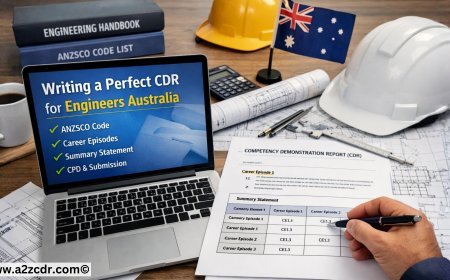








How to Showcase Your Engineering Competencies Effectively in a CDR
Learn how to showcase engineering competencies effectively in a CDR with clear Career Episodes, strong Summary Statements, and EA-aligned technical evidence.


For engineers aspiring to migrate to Australia, the Competency Demonstration Report (CDR) is far more than a formality. It is the core document Engineers Australia uses to evaluate whether your qualifications, skills, and professional experience meet Australian engineering standards. Many technically capable engineers receive negative outcomes not because they lack experience, but because they fail to present their competencies clearly and convincingly in their CDR.
Showcasing engineering competencies effectively requires a deep understanding of Engineers Australia’s assessment framework, strong technical storytelling, and precise alignment with competency elements. This article explains how to demonstrate your engineering competencies properly across Career Episodes, the Summary Statement, and Continuing Professional Development (CPD), ensuring your CDR stands out and meets assessment expectations.
Understanding Engineering Competencies in a CDR
Engineers Australia assesses applicants based on specific competency elements depending on the occupational category—Professional Engineer, Engineering Technologist, or Engineering Associate. These competencies evaluate not only your technical knowledge but also how you apply engineering principles, solve problems, manage projects, and uphold professional standards.
Competencies are not assessed through certificates or job titles alone. Engineers Australia looks for evidence-based demonstration of your skills. This means you must clearly show how you applied engineering knowledge in real projects, made decisions, handled challenges, and achieved measurable outcomes.


A strong CDR translates your engineering experience into assessable competencies using structured, technical, and first-person narratives.
Choosing the Right Projects to Demonstrate Competencies
The foundation of an effective CDR lies in selecting the right projects for your Career Episodes. These projects should reflect substantial engineering involvement rather than routine or administrative tasks. Engineers Australia expects projects that demonstrate engineering judgment, technical analysis, design responsibility, and problem-solving.
Your selected projects may come from professional employment or academic work, but they must involve genuine engineering activity. Projects where you were directly responsible for planning, analysis, design, implementation, testing, or optimization are ideal. Avoid projects where your role was purely observational or supportive. Each project should allow you to demonstrate multiple competencies, including technical knowledge, communication, teamwork, and ethical responsibility.
Writing Career Episodes That Clearly Demonstrate Competencies
Career Episodes are the most critical part of your CDR. They are detailed narratives explaining how you applied engineering knowledge in specific situations. To showcase competencies effectively, each Career Episode must be written in the first person and focus on your individual contributions.
Rather than describing what the team or organization did, you must explain what you personally did as an engineer. Engineers Australia wants to see how you approached problems, selected engineering methods, applied standards, and made decisions.


Strong Career Episodes clearly explain the context of the project, your role, the engineering challenges involved, and the technical solutions you implemented. The emphasis should always remain on engineering application rather than general management or coordination.
Demonstrating Technical Knowledge and Engineering Judgment
One of the most important competencies Engineers Australia assesses is your ability to apply engineering knowledge. This means going beyond surface-level descriptions and explaining the technical reasoning behind your actions.
When describing your work, explain why you selected certain engineering methods, tools, or technologies. Discuss calculations, simulations, design considerations, safety factors, standards, and constraints where relevant. This demonstrates your understanding of engineering principles and your ability to apply them in practical situations.
Engineering judgment is shown when you explain how you evaluated alternatives, assessed risks, optimized designs, or resolved technical conflicts. These details distinguish a strong CDR from a generic project description.
Showcasing Problem-Solving Skills Effectively
Problem-solving is central to engineering practice and must be clearly demonstrated in your CDR. Engineers Australia expects you to identify engineering problems, analyze them systematically, and implement effective solutions.
In your Career Episodes, clearly describe the challenges you encountered and why they were technically complex. Explain how you identified root causes, evaluated possible solutions, and selected the most appropriate approach. Where possible, include measurable outcomes such as performance improvements, cost savings, efficiency gains, or risk reduction. This structured approach shows that you think like an engineer and can handle real-world engineering challenges independently.
Highlighting Design, Analysis, and Implementation Skills
Engineering competencies are strongly linked to your involvement in design and implementation activities. Whether you worked on civil structures, electrical systems, mechanical components, or software-controlled processes, your CDR should highlight your design responsibilities clearly.
Explain how you developed design concepts, performed technical analysis, prepared calculations, selected materials or components, and ensured compliance with standards and regulations. If your role involved implementation, describe how you supervised installation, testing, commissioning, or system integration. This level of detail reassures Engineers Australia that you have practical engineering experience aligned with Australian standards.
Demonstrating Communication and Teamwork Competencies
Engineering is rarely a solo activity, and Engineers Australia evaluates your ability to communicate effectively and work within multidisciplinary teams. However, this does not mean shifting focus away from your individual role.
Instead, explain how you communicated technical information to colleagues, supervisors, or clients. Describe how you prepared reports, drawings, presentations, or technical documentation. Highlight instances where you coordinated with other engineers or professionals to resolve technical issues. This demonstrates that you can function effectively in a professional engineering environment while maintaining technical responsibility.
Addressing Professional Ethics and Responsibility
Engineers Australia places strong emphasis on professional ethics, safety, and responsibility. Your CDR should reflect your awareness of ethical considerations, workplace safety, and environmental responsibilities.
You can demonstrate this by describing how you adhered to engineering codes, followed safety regulations, conducted risk assessments, or ensured sustainable practices. If you identified potential risks and took corrective actions, explain these steps clearly. Such examples show your commitment to professional standards and responsible engineering practice.
Aligning Career Episodes With Competency Elements
Writing strong Career Episodes alone is not enough. You must ensure that your content aligns directly with Engineers Australia’s competency elements. This alignment is achieved through the Summary Statement, but it begins with well-structured Career Episodes.
Each Career Episode should naturally cover multiple competency elements. Avoid forcing content to fit competencies; instead, focus on authentic engineering work that inherently demonstrates those elements. When your Career Episodes are written correctly, mapping them in the Summary Statement becomes much easier.
Writing an Effective Summary Statement
The Summary Statement is where you explicitly link your Career Episode content to Engineers Australia’s competency elements. It acts as a roadmap for assessors, guiding them to where each competency is demonstrated.
To showcase competencies effectively, your Summary Statement must be precise, accurate, and well-referenced. Each competency claim should point to specific paragraph numbers in your Career Episodes where evidence is provided. Avoid vague references or overclaiming competencies. Engineers Australia values clarity and evidence over exaggerated statements.
Supporting Competencies Through CPD
Continuing Professional Development (CPD) supports your engineering competencies by showing that you actively maintain and upgrade your skills. While CPD does not demonstrate competencies directly, it strengthens your overall application.
Your CPD should include learning activities relevant to your engineering field, such as technical training, workshops, certifications, seminars, or self-study. Ensure that your CPD aligns with the competencies you claim in your CDR. This demonstrates your commitment to lifelong learning and professional growth.
Avoiding Common Mistakes When Showcasing Competencies
Many engineers weaken their CDR by making avoidable mistakes. These include using generic language, focusing too much on company activities, copying content from samples, or failing to explain technical reasoning.
Another common mistake is presenting job descriptions instead of project-based engineering work. Engineers Australia assesses what you have done, not what your role was supposed to involve. Avoiding these errors significantly improves the clarity and credibility of your competency demonstration.
The Role of Professional Guidance in Competency Presentation
Even experienced engineers often struggle to present their competencies effectively in writing. This is where professional CDR writing services, such as A2Z CDR Writing Services, can provide valuable support.
Expert guidance helps ensure your Career Episodes highlight the right competencies, use appropriate technical language, and align perfectly with Engineers Australia’s expectations. Professional review also helps identify gaps, strengthen explanations, and ensure compliance with assessment guidelines.
Showcasing your engineering competencies effectively in a CDR requires more than technical experience. It demands clear communication, structured presentation, and precise alignment with Engineers Australia’s competency framework. By selecting the right projects, writing detailed Career Episodes, demonstrating engineering judgment, and mapping competencies accurately in the Summary Statement, you can significantly improve your chances of a positive assessment.
A well-prepared CDR does not just prove that you are an engineer—it proves that you are ready to practice engineering at Australian standards. With careful planning and expert guidance where needed, your CDR can become a powerful tool in achieving your migration goals.
What's Your Reaction?
 Like
0
Like
0
 Dislike
0
Dislike
0
 Love
0
Love
0
 Funny
0
Funny
0
 Angry
0
Angry
0
 Sad
0
Sad
0
 Wow
0
Wow
0